Monday, February 26, 2024

Entrenched in Civil War history, Vicksburg, MS plays a vital role in the fall of the Confederacy.

So far, our trip through the southern states has been really “eye opening”. I mean that very sincerely. When I start planning a 16-week trip, I can only take a cursory look at the attractions available in the community surrounding a campground. There are many factors that go into selecting a route and the stops along the way, and we are never entirely sure what we will find.  Not knowing what we’ll find makes stops more intriguing and we really try to explore the area.  (As a small aside, I could not imagine trying to route our travels without Google maps and the RV Trip-Wizard software application. These two website programs, in my opinion, have made RV trip planning, dare I say, fun.)  For this trip through the southern United States, I accidentally, but really on purpose, put together a trip abundant in Civil War & Civil Rights history. Mixing in some resort type campsites like St. Augustine, and Cedar Key, FL with more historical places like Charleston, SC and Montgomery, AL.  

And what I have encountered these last 10 weeks or so has enlightened my perspective and deepened my understanding of how destructive the Civil War was in our nation’s history. The only war strictly fought on US soil between US citizens. And nothing drives this message home more forcefully than a trip through the 2,500-acre Vicksburg National Military Park. This park commemorates one of the most decisive Civil War battles, the campaign, siege, and defense of Vicksburg, MS. Confederate president, Jefferson Davis believed that, geographically speaking, Vicksburg was the lynchpin holding the Confederacy together, by connecting Louisiana and Texas to the rest of the Confederate states. The Vicksburg campaign was waged from March 29 to July 4, 1863. It included a half dozen battles in west-central Mississippi, as well as a 47-day long siege by the Union army under the command of Ulysses S. Grant against Confederate forces defending the heavily fortified city of Vicksburg. Located high on the bluffs, Vicksburg was a fortress guarding the Mississippi River. It was known as "The Gibraltar of the Confederacy." Its surrender on July 4, 1863, coupled with the fall of Port Hudson, Louisiana, divided the South, and gave the North undisputed control of the Mississippi River. The historic battlefield includes 1,325 monuments and markers, 20 miles of reconstructed trenches and earthworks, a 16-mile tour road, 144 emplaced cannons, the restored Union gunboat-USS Cairo, and the 116-acre Vicksburg National Cemetery.  My gosh, what we have learned about the Civil War on this trip through the southern states, has just been mind-blowing. By now Judy and I have found ourselves repeatedly saying, “this is nothing like 10th grade US History we were required to take in high school”.


By the way, Vicksburg is situated on this crazy bend in the Mississippi River, up on a hill, in such a way that you can clearly see the river flowing from the north, then turning due east as it approaches Vicksburg, before turning south again in an exaggerated “S” curve. A layout you’d be more inclined to see on a BMX racetrack, and not the great Mississippi River. No surprise, this means Vicksburg is on a rather steep hill as you move away from the riverbank.

Closest to the river is The Old Depot Museum. Housed in the old railroad depot building and adjacent to the Mississippi, it doesn’t take much imagination to envision this area as a bustling port and transfer station where riverboat cargo was transferred to trains bound for the east coast. The museum is committed to preserving Vicksburg’s rich history and heritage. The museum is home to over 100 models of Civil War gunboats, an amazingly accurate diorama of the Battle of Vicksburg, as well as a stirring video of the trials of the citizens and soldiers during the siege. But the best part of this depot museum was, once again, the model trains and associated railroad equipment. The Old Depot Museum is dedicated to the railroad industry and features N, O and HO layouts, complete with buildings, scenery, and architecture. Just an eclectic collection of artifacts all tied to Vicksburg.


From the Depot we walked up the rather steep riverbank, to the tallest bluff overlooking the Mississippi, where the old Warren County Courthouse sits. Which is now a museum. The courthouse was a prominent symbol of Confederate resistance during the Siege of Vicksburg. During the Civil War, the building was one of the main targets in Vicksburg. As hard as the Union tried, the building suffered only one major hit. After a 47-day siege, on July 4, 1863, the Stars and Bars were lowered, and the Stars and Stripes were raised. On the second floor is the courtroom where trials were conducted. During the Reconstruction-era, the Warren County Courthouse was the site of the first brutal event related to the Vicksburg massacre, when Black citizens were attempting to reinstate the newly elected Black sheriff, Peter Crosby, who had been coerced at gunpoint by a white militant group to sign a paper of resignation. The unrest eventually ended with the arrival of the US Army the following year. We lost track of time exploring this museum so, not unsurprisingly, we were halfheartedly chased from the museum by the only remaining staff member, as we lingered through the exhibits on the second floor, until well after closing. There were just so many original artifacts of the last 300 years of US history, it was easy to get caught up in the displays and pieces.


Judy sitting in the witness chair of the old courtroom.

And for a bit of fun, we visited the most haunted house in Mississippi, called the McRaven House, on a blustery and rainy Saturday night, complete with thunder and lightning. McRaven haunted tours were led by theatrical guides in time period costumes who gave a brief history of the Vicksburg, MS families who occupied this historic house for 200 years. The house was added onto in three distinct time periods of US history, giving this residence quite a storied past. I think the best part was watching the guy wearing a Ghostbusters costume complete with utility belt and ghost detecting equipment slink around the house activating the detector in search of a ghost. It was all a lot of fun and a great way to spend a rainy Saturday night.


Vicksburg is not a big city, and right about the time we had figured out where everything was situated and how to maneuver around the town, it was time to pack up the RV and head north for another state neither Judy nor I had ever visited. That state is Tennessee. This is our first of four stops in Tennessee, so for the next month or so we might just have to consider ourselves residents. Our fist stop is in Memphis, where we may visit Stax Museum of American Soul Music, or see where Martin Luther King Jr. was assassinated at the Lorraine Motel, or even visit Elvis at Graceland. These are just some of the attractions on our radar, but you’ll have to read our next blog as we tell…the Rest of the Story.

Monday, February 12, 2024

Not all destinations are as charming & engaging as New Orleans, but we do our best.

Our tour of the southern states of the US is reaching its halfway point. We are 14 stops into our 24-stop trip and still learning about the nomadic RV lifestyle. Here are a couple of unintentional observations:   

  1. Families with children in campers on vacation have disappeared from the landscape. Sure, we do bump into the occasional family with children probably being home-schooled and living in a camper, but for the most part we have seen very few kids. 
  2. Some RV campsites are more touristy, and some campsites are more of a working-class neighborhood. When you hear diesel truck engines starting at 6:00 am in the morning, and slowly driving off for the day, you know you’re in a working-class RV campsite. And it all makes sense now because we are in a southern climate where living year-round in a camper is feasible.  
  3. When we visit cities, towns or regions, the activities and excursions usually fall into two basic types. There is, what I would call, pastural, with lots of park land and / or beaches, with a more laidback atmosphere. Then there are the metropolitan type places, with museums and galleries and a distinctly upbeat vibe.   
  4. The weather “can either win the horse or lose the saddle”.  True, the cold and snow of a typical New England winter is all but a distant memory for us, so I’m sure there’s not much sympathy from people tolerating winter weather. The weather can really be a factor in determining how robustly we can explore a place.  Anybody who has taken a week’s vacation in a tropical paradise only to have it rain for 4 out of the 7 days, knows that the weather can wreak havoc on a trip.  Some stops are better suited to accommodate poor weather, but ultimately mother nature can be a delightful friend, or bitter enemy. 

Although these observations appear unrelated, we have found them to have an impact on our experiences at a destination. This is especially true when these observations or attributes are found to be prevalent in certain combinations.  Here are a couple of examples:  a) Poor weather can be better accommodated at a metropolitan type of stop. b) Touristy campsites will have more families with children. c) Working class campsites in metropolitan areas are very quiet during the day.  And then there’s the doomsday scenario: poor weather, at a touristy campsite, in a pastural area.  Auggggh, the worst!  All of a sudden, the unrelated observations detailed above have a profound impact on our ability to explore our destination.

That best explains our 7-day stop in Gulf Shores, Alabama, which is where we went after leaving the unseasonably cold state capital of Montgomery.  Our stop in Gulf Shores was a bit of a dud. We were at a lovely RV park, very touristy in nature with a pool, and a club house, only 2 blocks from some of the nicest beaches on the Gulf out on the barrier island.  And the weather absolutely sucked. It was either windy, raining, or cloudy for all but 1 day of our visit. The wind blew the beach sand everywhere, the rain and drizzle meant that just stepping outside inevitably had us tracking sand wherever we went, and walking along the beautiful long and fine white sand beach in the cloudy damp weather was not enjoyable. How bad could it be you ask? So bad that we have a combined total of ZERO pictures from this stop. I was tempted to not even mention this stop in the blog, pretending it never happened. As the saying go, “pics or it didn’t happen.” Enough said.

Then just one week later we found ourselves in New Orleans, LA. Here we had five mostly sunny days, parked in a working-class RV campsite, in a metropolitan area. Just a great combination of attributes for a magnificent time touring and exploring New Orleans. The campsite was situated on the bayou, 11-miles south of the French Quarter.  We found that using UBER for day trips into New Orleans was the simplest, and most cost-effective mode of transportation (parking the truck in the city is expensive).  Needless to say, it was a busy week full of adventure and sightseeing. Let me see where to begin.

So much to tell, so let’s get the basics out of the way. We did the usual touristy activities, including having Beignets & Cafe Au Laite at Café Du Monde, complete with a 5-piece brass band.  We walked the French Quarter, visiting shops, eating food, and watching sidewalk musicians and entertainers work the crowd. We visited Lafayette Park, and perused paintings and handcrafts displayed therein. We tried and ate gator and roasted oysters (yum).  We walked along the French Quarter Riverwalk, visiting the New Orleans Holocaust Memorial with art by Yaacov Agam.  And….


  • What would a trip to New Orleans be without a food tour in the French Quarter? Incomplete, that’s what. We signed up for a 2 ½ hour walking food tour with Kristi of Destination Kitchen. We started with a treat of Kings Cake from Roux Royal, then moved onto Shimp Po’boy at Dickie Brennans Tableau, and ended with fresh Pralines from the New Orleans School of Cooking. But our favorite stop in the middle was at the New Orleans Creole Cookery, where we sampled, for the first time, Jambalaya, and roasted oysters with parmesan cheese. New Orleans truly is the melting pot of so many cooking cultures, and the food was amazing. I could go on, but writing this is making me hungry.

Beignets at Café Du Monde
Shimp Po’boy

Fried Gator and Broiled Oysters
  • We spent a sunny day visiting and exploring New Orleans City Park, which was modeled after Central Park in NY City. There is much to see within the confines of the 1,300-acre park, including a Botanical Garden, the New Orleans Art Museum, a Storyland Park, and a Stadium. We brought a picnic lunch and walked much of the park, including the outdoor sculpture garden associated with the Art Museum. The highlight for me was the historic New Orleans Train Garden. This gem of an attraction is tucked away in a lush corner of the Botanical Garden. Here, model trains 1/22 of the actual size zip around 1,300 feet of track carrying streetcars and trains like those that traveled the city in the late 1800s to the early 1900s. Live bonsai plants are used in the landscapes.  It was so much fun to watch the trains go around the multitude of tracks. Much of the rest of the Botanical Garden was seasonally dormant, but the walk through the Japanese garden was calming with the towering bamboo trees, tranquil waterfalls, and Japanese inspired sculptures. 


  • We drove to visit the town of Madisonville, LA, which required us to drive across Lake Pontchartrain, which lies to the north of New Orleans. Driving from shore to shore across this 24-mile-long bridge is freaky, because when you’re 5-miles away from the departing shoreline, one cannot see land anywhere. An endless bridge that seems to lead into the middle of water.  
  • Our campsite south of the city was convenient for driving further south into Jefferson Parish and the bayou.  At the southern tip of Barataria Bayou there lies the unincorporated village of Lafitte, LA.  Most of this town sits on or abuts marshes and mud flats. Our first stop was The Wetland Trace Nature Boardwalk.  Here we found a park which contained a couple of miles of elevated boardwalk that allowed us to explore the 41 acres of wetlands. We saw wild alligators for the first time, as they laid sunning themselves on the mud flats. We found a picnic table and had lunch. The “gators”, as they are called by the locals, were not interested in us or our lunch (If you can believe it there were signs indicating not to feed the alligators).  Our second stop was at Airboat Adventures for a 2-hour ride on an airboat through the bayou. We boarded a small airboat, on a warm sunny afternoon, with an experienced guide, and cruised through the cypress swamps & bayous to see alligators, snapping turtles, herons & hawks. Ever been on an airboat before? That makes two of us. When the engines are cranked up, these machines are a thrill a minute. But they are also capable of silently gliding into delicate bogs where alligators lie in groups and snapping turtles sun themselves on logs. We found ourselves thoroughly engrossed in the natural beauty of the cedar, live oak, and bayou environment. One of our best excursions, and hopefully the included pictures give the experience proper justice.


Wetland Trace Nature Boardwalk


I think I have whiplash. There was just so much to do and see in and around New Orleans, which was a complete flipside from our week in Gulf Shores, AL. The key to the success of any stop on our journey is, of course, the weather. If the weather had been more cooperative, then Gulf Shores would have been a fabulous beach stop, and one that we will have to try again. In the meantime, we will be remembering our stop in New Orleans for years to come. And just like that, our seven days stop in Bayou Barataria RV Park was over. We had reached the westernmost point on our southern tour and were headed north to Vicksburg, Mississippi. Another week, another new state.  But not without one more pass through the city of New Orleans, as we drove around the west side of Lake Pontchartrain, to pick up Interstate 55 north as we continue our travels and tell the Rest of the Story.


Monday, January 29, 2024

Civil Rights was on our minds for our week’s stay in Montgomery, Alabama.

Blissfully unaware. When we’re traveling, we kind of live in a bit of a bubble; aware of the world around us, but not as engaged as we usually are. Honestly, the phone applications getting the most attention these days are Accu-weather and the NOAH RADAR NOW app. We’ve paid little attention to sports or the NFL playoffs, politics, or international news, and I think it’s a consequence of traveling. Each week we move to a different city, state, or region, and much of our attention is spent on sightseeing and discovery. Funny how I now know more about regional grocery store chains such as “Rouse’s Market” and “Piggly Wiggly” than I know about what 4 teams are in the football playoffs this year.  What has happened to us?

There are a couple other factors at play here. Whenever we take our home on wheels on the road for extended traveling adventures, we become super focused on learning and exploring as much as possible.  There are walking trails to explore, museums, churches, sidewalk markers, waterfronts, and historic downtowns to visit. So, we’re kind of in our own simpler information bubble. Not being attached to a workplace also plays a role. There are no workplace colleagues with whom to discuss current events.  And before you know it, we have just tuned out much of the world.  Our stop in Montgomery really shook us out of that mentality.

The last three stops on our voyage were centered around beach communities (even if the weather was not cooperating), but the Montgomery stop, planned months ago, was intentionally planned to break the beach resort pattern.  On many of our stops across the southern states, we have gotten great insight and understanding of the American Civil War.  We knew stopping for a week in Montgomery, Alabama meant a deep dive into the mid-20th century Civil Rights struggle. Some of what we saw was disturbing and uncomfortable. You need to visit Montgomery --walk the streets, see the sidewalk markers, visit the museums-- to understand how complex this city is and how profound an impact it had on the Civil Rights Movement.  We walked through the capital city streets most days of our visit, looking for and reading the markers and remnants of the Civil Rights struggle. 

Let’s start with some basic info. We visited Montgomery during some of the coldest weather of the year.  So, although Judy and I were quite accustomed to temperatures in the low 40’s with a stiff 15 mph wind, many in Montgomery were not, and, as we understand it, school was cancelled for a few days. On the other hand, there was brilliant sunshine and Montgomery is very walkable, so we tried to stay on the sunny side of the street. We visited a couple of days in a row, and this capital city just seemed to lack the hustle and bustle of similar state capitals. On-the-street metered parking was always available, restaurants were not busy, and a couple of times it felt like we were the only ones visiting. 

Frozen Fountain in Montgomery


We did eventually see Montgomery with some excitement & liveliness when we ventured into town on a Friday night for dinner and a concert. The restaurants around the Performing Arts Center were busy and there was a good crowd of attendees to see the show. It was one of the few times I had to scout to find a parking spot. Once again, Judy snagged us concert tickets. We were in the 5th row to see the Black Jacket Symphony playing Journey’s “Escape” album.  All 9 chart topping songs.  And after intermission, they played Journey’s greatest hits, for another 45 minutes. They played Journey unbelievably well! They had found a lead singer who, if you closed your eyes, made you think you were listening to Steve Perry himself. What a great night and a great performance; we recommend attending a Black Jacket Symphony show if you ever get the chance (they have different members, depending on the album and band being showcased). Just take a listen.

Fortunately for you, my dear readers, I will not attempt to recount all the places we visited.  Montgomery, being the state capital, meant that we had access to the Alabama State Department of Archives and History. We spent a couple days visiting this mammoth-sized building, which houses all of the state’s archived records, and even has an exhibit detailing Alabama’s history from the time of the Native Americans.  Having never been to this state before, this exhibit was a great place to start our exploration, providing the topography and history of Alabama as a background. With regard to the Civil Rights Movement, and the historic events which took place in Montgomery, the following are the most moving and informative attractions we had the pleasure, and sometimes the discomfort, of visiting:

  • Rosa Parks Museum, part of the Troy University campus, was one of the first museums we visited. It is located at the site of Parks’ famous arrest and is centered on Parks’ story and its place in the Civil Rights Movement. Historic markers on the street outside designate the site where Rosa Parks boarded the public bus and where she was arrested for refusing to give up her seat to a white passenger and move to the back. This exhibit, having just been re-opened after renovations, is so unbelievably realistic. Visitors experience the events on that fateful day as an observer, watching and listening to the exchange between Rosa Parks, the bus driver, and the police. It was chilling. You kind of wanted to step in and say something yet can clearly understand why no one did.  Within a week of Rosa Parks’ arrest the black citizens of Montgomery organized and executed the Montgomery Bus Boycott of 1955. Black people were treated so horrendously on Montgomery public buses. It was ugly, and it gave me a visceral feeling of anger.  Even as I write this, I can feel those strong emotions bubbling under the surface as I pound on the keyboard of my computer.

  • And still, 6 years after Rosa Parks was immorally arrested, the mistreatment of black people using the bus system for interstate travel continued. The Freedom Riders started riding the Greyhound and Trailways bus lines in the south and were getting beaten up by angry mobs. The Freedom Riders, black, white, male, and female, of all ages, stepped off a bus at the Montgomery Greyhound Station on May 20, 1961. They were prepared to meet mob violence with non-violence and courage. They prepared farewell letters and wills. Their goal was to help end racial segregation in public transportation. And they did. There is a museum, in the exact Greyhound bus station where all this happened. I was so unprepared for the museum, I almost walked past. Walking up the street I noticed a building with that familiar brick façade of a bus station supplemented with the famous Greyhound logo before realizing that the bus station was the museum.

  • Lastly, there was the Legacy Museum.  Augh!  I’m almost unable to explain this museum in words that will do justice to the experience of visiting this place. And you must visit this museum. Here’s why. Ever been to a Holocaust Museum?  Remember that feeling of nausea and abject horror of such inhumanity? Well, I had the same reaction in the Legacy Museum. Capturing people, separating families, and shipping people on boats for a life of slavery is dreadful. Then the museum illustrates the effect of segregation and the Jim Crow laws of the south, which made it legal for state governments to treat Back people as second-class citizens. Nope. It’s not over yet, because after we enacted the 14th amendment, and established the voting rights laws of 1965, we still allowed the lynching of black people. Horrific!  As late as 1974, when the last recorded lynching took place, over 4,000 innocent black men, had been dragged from their houses or some such hiding places by an angry mob and hung. The bodies were left to hang in plain sight to “teach others a lesson”.  Very, very disturbing.  I could go on, but I’m not going to.  If you can, visit this museum. Learn from the mistakes of the past. This story needs to be told and never forgotten. 

Writing about our stop in Montgomery was not easy.  We bore witness to the grim realities of racial injustice, and the roll that Montgomery played in the American Civil Rights Movement. What an education we got! Our visit to Mongomery challenged what we thought we knew but about the mid-century Civil Rights struggle, but really did not. The education was not always pleasant but was significant and unforgettable. The weather is starting to get warmer as our one week stay in Montgomery is ending.  Next, we are headed to southern Alabama, a place on the beach called Gulf Shores. One of the barrier islands outside Mobile Alabama Bay. Unfortunately, although not as cold, the weather is looking rather rainy.  Thanks for following along as we tell …the Rest of the Story.

Sunday, January 21, 2024

A town with a fun name called to us as we explored the Florida panhandle.

One of the benefits of our 5th wheel configuration is that we have the flexibility to deposit the camper in an RV campsite, and then use the Beast (truck) to explore the surrounding area. So, we get to explore more than one town at any given stop. And this flexibility was especially helpful for our visit to Mexico Beach, FL.  The Beast allowed us to roam up and down the coast of the Florida panhandle. This is not the first stop in which we roamed the area. 

Some of the towns or cities we wander into have names that just seem to catch our attention. This is typically how it works. We are reviewing our current location at a new campsite using Google maps. We are in search of a restaurant, gas station, or grocery store. And that’s when we see it! See what? The name of a town that just piques some curiosity.  Example: Cheboygan, MI (the CH are pronounced sh.) We discovered Cheboygan in August of 2023 whilst visiting Mackinaw City. We were looking for a full-service supermarket, which just wasn’t available in the heavily tourist-oriented Mackinaw City. Cheboygan just made us chuckle, so we went. The next town which called to us was in Canada. Port Perry, Ontario, overlooking Lake Scugog. Scugog was just such an unusual sounding name for a lake. We went and found the best town fair we had ever visited. There was a lumberjack demonstration and tractor pull competition. The highlight was being in the grandstands for the BMX Motocross areal show (see blog “We have left the States to explore Canada visiting Uxbridge & Port Perry” dated Sept 24, 2023).  Port Perry on Lake Scugog. How could we not go?  

We drove through Apalachicola, on our way to Port St Joe, FL, and basically fell in love with the name, uttering it repeatedly as we passed each sign. Apalachicola. The name has a lot of syllables. Names with lots of syllables are fun to say and Apalachicola has six. Our campsite was in a place called Mexico Beach. West of our location was the sprawling Tyndall Air Force Base followed by Panama City.  East of our location was the small town of Port St. Joe, followed by Apalachicola. Nearly 60 miles of the Florida panhandle coastline to explore.  For obvious reasons we started in Apalachicola.

Originally, Apalachicola was a small settlement at the mouth of the Apalachicola River. In 1828, steamboats operated between Apalachicola and Columbus, Georgia, carrying manufactured goods to upriver towns and plantations and returning with cotton destined for mills in New England and Europe.  David G. Raney and his wife, Harriett, were Virginians who came to Apalachicola in 1834. Raney quickly established himself as a cotton trader. Raney built the two-story Federal Style colonial house in 1838, overlooking the bluff along Market Street. The Raney family continued to live in the house until 1914. The city purchased it in 1973 and today it serves as a museum. All of the artifacts in the house are original.  Original clothing, original rugs, furniture, and décor, as well as original paintings and pictures.  Apparently, Raney was also an investor in the Confederate States of America. There are dozens of Confederate war bonds, in picture frames around the house / museum, all of which were worth nothing when the Civil War ended.  We spent a very enjoyable couple of hours with historian Janyce as we learned about the local history and the Raney family.

Working our way west from Apalachicola found us on the St. Joseph Peninsula and in the T.H. Stone Memorial St. Joseph Peninsula State Park.  A beautiful state park with miles of sugar-white sand. We walked along the beach, which has often been ranked among the best in the United States. We also walked the mile plus Bay View trail, amongst the high dunes and sand pin scrub along St. Joseph’s Bay.  As you can tell from the pictures below, I came home from this visit to the beach with a bit of a tan. Judy, on the other hand, dressed in anything but beachwear, and got a lot of sand in her hiking boots. Admittedly, it was not much of a beach day.  Although there was plenty of sun, there was also a brisk 20 mph breeze coming off the Atlantic, with temperatures in the low 60’s. A lovely day at a beautiful Florida state park.

Interesting beach attire!

Interesting tree!

And, of course, there was the obligatory visit to the local lighthouse. In this case, I’m talking about the Cape San Blas Lighthouse. Cape San Blas is a 750-acre section of land that juts out into the hurricane prone Gulf of Mexico from the crook of the narrow St. Joseph's peninsula. In 1847 Congress appropriated $8,000 for a lighthouse. Two years later a conical brick tower was completed. During a storm in 1851, this first structure was destroyed.  In 1857 a brick lighthouse was again erected, just prior to the beginning of the Civil War. The wooden parts of the tower and both keepers' houses were burned by Confederates. The lens, oil, and tools were hidden away in Apalachicola, preserved for future use. The lighthouse returned to operation on July 23, 1865. By 1882 beach erosion had all but destroyed lighthouse #2. In 1883, the Lighthouse Board approved the erection of a skeletal tower (view photo). The "skeletal" lighthouse has eight cast iron legs that support the "watch room" and lantern at the top of the tower. The legs are bolted into a concrete foundation. Beach erosion and storm activity necessitated the lighthouse and keepers’ quarters be moved a number of times before eventually being taken over by the City of Port St. Joe and moved to its current location in Port St. Joe. This lighthouse has a third order bi-valve lens made by Rarbier Benard and Ture and stands 101 feet above sea level. 


But I think what we will remember most about our stop in Port St. Joe was the sunsets from Mexico beach over the Gulf of Mexico. After a busy day of touring, we were fortunate enough to be back at the camper early in the afternoon. We pulled out our beach chairs, packed up a small cooler and walked a short way down the road to the beach. Sipping peanut butter infused whiskey, while spending the final hours of the day watching the sun slowly set, was a perfect way to end our visit to the Florida panhandle. 


Enough!  We have had enough of the beach (okay, not sure if that’s really possible).  We’re packing up this time and heading inland, due north to Montgomery, Alabama. The state capital and the birthplace of the 1960’s Civil Rights Movement. We have had four great stops in Florida, but we need to get back to learning about important American history. This will be both Judy and my first visit ever to Alabama, a state we know very little about. We will have lots to see and do in Montgomery as we tell…the Rest of the Story.

Monday, January 15, 2024

We go coast to coast in Florida.

We’re a little confused. Maybe confounded is a better term. The problem is simple, but also very complex. It goes something like this; “We do not know exactly what time it is?”. Yup, I said it. Time is confusing us. Now, before you start thinking this retirement stint has initiated some deterioration in our cognitive function, let me ask if anybody has ever lived on the time zone line? Literally, that exact spot where the time zone changes from one time zone to another?  We would like to meet that Facebook group of people who live so close to the time zone that crossing the road means an hour difference in time. This is our current situation. We have no experience in this kind of environment, so we have been forced into some draconian coping measures. The clocks in the RV have all been changed to central time, with labels indicating “CST”. My personal watch has been left on east coast time, and the cell phones alternate between times, depending on where GPS determines our location. We’re like bouncing between two worlds.  

I'm so confused.

Such are the burdens of our current situation, (to be honest not much of a burden, although it makes a nice transition), since our previous two stops had us firmly planted in the eastern time zone.  We left St. Augustine, FL on a Monday and headed due south, following the I-95 corridor for 190 miles to Fort Pierce. Only about an hour’s drive north from the Palm Beach area. There was not as much sightseeing or walking in Fort Pierce as there was visiting friends and family.

First and foremost, we were far enough south in Florida to be within driving distance of Judy’s parents, Helen and Jason, in Boca Raton. Now in their early 90’s, we have been flying down regularly to visit them.  Finally, we were close enough to facilitate a visit to the RV.  The plan was to pick them up and return with them to the RV to have lunch. We all had a lovely sit-down lunch in the camper. (Mother nature was not kind to us on this day, as it rained.  Lunch had to be served indoors.)  For years we have been telling Helen and Jay of our intended RV lifestyle plans.  A lifestyle I’m not sure they actually understood. They do now. It was a busy day for the elderly couple, but a memorable one, I’m sure.

We also had the occasion to visit with some dear friends, formerly from our hometown, Jane & Ned.  The story goes like this.  Jane and Ned lived in our neighborhood, 2 doors down, for the better part of 20 years.  We watched each other’s kids grow up. A couple of years ago they decided to sell in Massachusetts and take up residence in Florida.  We watched them move out about 18 months ago. Before leaving for this trip, Judy was smart enough to get an address and phone number, and after google mapping the locations, we discovered that our stop in Ft. Pierce would be close enough for a visit, if one could be arranged.  And visit we did! They have a stunning home; Ned is a construction craftsman and Jane has an amazing home decor style. Walking through their Florida home was like visiting a House Beautiful magazine. Just so refined and tasteful. We got a chance to walk through their neighborhood, which is nestled on the intercoastal between the Indian River and the Atlantic Ocean. Time passes quickly when the conversation flows so freely, and as the afternoon waned, we said our goodbyes, and headed back to our campsite.

Jane, Ned, Judy, Steven


But not all of our time in Fort Pierce was for visiting family.  New Year’s Eve found us traveling to West Palm Beach and the Kravis Center for the Performing Arts to see Fortune Feimster (Fortune Feimster Comedian Official Web Site), a VERY funny woman, and a wonderful way to spend the early hours of New Year’s Eve. Again, Judy’s last-minute clever investigation of shows and performances in the area pays off with a memorable night of laughter.

Fort Pierce “was so 2023”, and once the calendar changed to 2024, we were headed west across the state of Florida to the west coast. To the small town of Cedar Key. Cedar Key juts out into the Gulf of Mexico, some 60 miles south-west of Gainesville, FL, and requires a 21-mile drive along State Route 24 from the only crossing route.  There is only one way in and one way out of Cedar Key.


And from this vantage point we were fortunate enough to witness some of the most beautiful sunsets over the water and the gulf shores. The key is surrounded by small islands of Mangrove trees. The mangrove flourishes, even with their roots always engulfed in saltwater, and the small islands litter the area appearing as green tops during low tide when the clam-laden sandy sholes are visible. We had booked a campsite that was 1 ¼ miles to the center of town and easily walkable, and it has one of the most authentic Tiki bars Judy and I have ever visited. And visit we did!  We had a wonderful experience at a 21 and over RV campsite nestled along the Gulf of Mexico. Low Key Hideaway is very small, with only 10 full-service campsites that back right up to the shoreline. The Tiki bar, which is on the premises, is renowned for its stunning sunsets, and distinctive afternoon cocktails. There was live music on weekend nights, but the afternoon sunsets were truly something very special.

Sunsets on Cedar Key, FL

Needless to say, we did a lot of walking.  We walked into and out of town a number of times, whether to do some sightseeing or to eat dinner at one of the boardwalk restaurants. And as we walked into town for the first time, we were amazed at the amount of damage caused by hurricane Idalia. Idalia was a category 3 hurricane that made landfall at nearby Keaton Beach on September 2, 2023, and Cedar Key saw a record storm surge of almost 7 feet. This is still a community rebuilding after a terrible storm, and I’m kind of happy that I brought economic tourist dollars back into this area. Many of the stores and restaurants were closed and/or rebuilding. But we did find “Tony’s Chowder House”, a restaurant whose specialty is New England style clam chowder made from scratch, with locally harvested clams, that was just spectacular. So good that we bought a couple cans to make for ourselves.


We regained our walking and hiking routines after a bit of a hiatus in Fort Pierce, stringing together a number of days of having more than 11,000 steps each day, which equates to over 4 miles. One of our best days was a trip north, through the town of
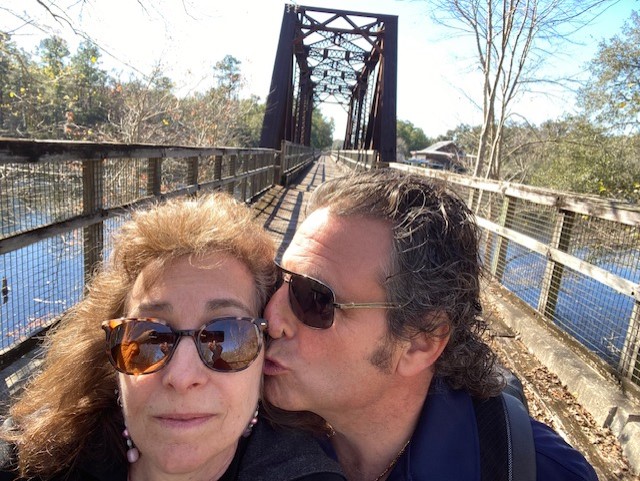
Chiefland and into Fanning Springs, where we were able to park and walk Florida’s Nature Coast Trail system. This system of trails runs for 32 miles, and we followed the trail east for about ¾ of a mile before coming to, and walking over, the historic 1902 Suwannee River train trestle bridge. Very picturesque, and although temperatures were only in the low 60’s, we had a lot of sunshine, so it really was a great days’ walk.

Suwannee River train trestle bridge

Lastly, and this was truly a highlight of our visit to the area, was a trip to Three Sisters Springs in Crystal River, FL. The springs are part of natural inlet in Crystal River which contains three natural springs. This is where manatees migrate in the winter to stay warm in the natural springs’ 74-degree temperature. Manatees spend the summers roaming the warm ocean waters and, in the winter, take refuge amongst the warm natural springs. And there were hundreds of them in the clear turquoise waters along the canals and natural spring ponds, maybe thousands.  As water mammals, the manatees must come to the surface to breathe, and are therefore in constant motion slowly rising to the surface where you easily hear them breath before submerging again to huddle around the warm water springs. They are well protected in this enclave, and the manatees’ only real threat is man. We develop the coastal areas where they feed on sea grass, we cut them up with our boat propellers, or we ensnare them in our fishing lines and nets.  But in Three Sisters Springs, they are well protected, at least for the winter, and so much fun to watch.

Selfie with Manatees 

Before we knew it, our week was complete. Unfortunately, the forecast for our Tuesday travel day was not good. We would be leaving Cedar Key in the morning, before the predicted rough weather and high winds moved into the area. But that also meant we would be pulling along our 16,000-pound camper, shaped like a box, into and through the storm. On the other hand, once through the weather and upon arrival in Port St. Joe along the Florida panhandle, the storm would have gone past, thus allowing us to park, level out, connect to the utilities, and open up the camper in better weather conditions. I’ll tell you now, we made it without much issue, but you’ll have to wait to read next week’s post as we tell…the Rest of the Story.

Sunday, December 31, 2023

We start our visit to Florida in historic St. Augustine

Still learning about myself. Crazy as it sounds, it’s the honest truth. This statement from a man who literally brought a bologna and cheese sandwich to work every day for 30 years. I’m pretty sure I know who I am and what I’m not. So, what’s the big revelation you ask? Well, I never imagined that I’d enjoy sitting outside the campsite, opening up the computer, and spending several hours creatively writing a blog. Who are you?!? Yet, here I sit, outside the camper, with a campfire flickering in the background. The aura is soothing, and I find the words and sentences just flowing together. Sometimes too much, but, thankfully, Judy’s a good editor, and can take my run-on sentences and add punctuation. She makes my nattering readable. 

 There’s another benefit of my evening dalliances: I get to listen to the sounds coming from the surrounding environment. And by the surrounding sounds, I mean from the immediate neighborhood around me, which can be inside the RV park or outside. I’ve sat outside so often, and at so many different RV parks, that I have started to recognize the sounds attributed to certain campgrounds. For example, our last campsite was in a 1,100-acre regional park, 1 ½ miles from the main entry road. As you may expect, it was a very quiet campsite. Because we were out on an island, separated on 3 sides by water or marsh, there was neither any outside “city noises”, nor any light pollution. At night, it was dark and quiet. In contrast, our stay in St. Augustine was out on the intercoastal, 1 block off the famous coastal Florida State Rte. A1A. This was a loud location. Ambulances, trucks, the sound of children, and music, all infiltrated our campsite. I have come to find that we encounter two basic types of camping experiences: we are in a rural park like setting, or we are in a very city like surrounding. Urban campsites usually mean we can walk to get groceries or go to a restaurant. Rural campsites have walking trails and fishing, but if you need anything from the drug store, you’re getting in a vehicle and driving at least 10 minutes. We love both types of campsites and use different strategies to make the best of our stay. And this changes from week to week. Let’s say you live in suburbia but have a friend (or cousin) who has a townhouse in NYC. Then you decided to switch houses for 30 days. Wouldn’t that be kind of exciting for a month? And when you get back to your original house after being away for 30 days, you’d get to re-engage in your previous life. And we do this every week. Just amazing! 

Our stop at a KOA in St. Augustine Beach was within a 4-mile drive from the old city of St. Augustine. We could not have been better situated for visiting this historic town. And to some extent, the weather even cooperated, allowing us to really get out and discover the area. Where should I begin..? How about starting at the “Fountain of Youth”. 

  • Ponce de Leon’s Fountain of Youth Archaeological Park. An interesting attraction, not exactly what I expected. But then again, I had no idea who Juan Ponce was of Leon, Italy, so I had a lot to learn. Surprisingly, there was an actual natural spring which pushes water from the Florida aquifer. It is believed that Juan Ponce discovered the town of St. Augustine, and that this spring would have been available as fresh water for Juan Ponce’s ships. The natural spring is the oldest roadside attraction in Florida, with visitor records going back to 1868. There were cups, and indeed there was water flowing. As an experiment, Judy had some water from the “Fountain of Youth”. I did not. We’ll see how this plays out. For many years, the area was an active archaeological excavation, with many discoveries about the native Timucua Indians. There was a live fire canon demonstration, as well as a Blacksmith studio. We would have stayed longer, but the sun disappeared in the early afternoon; so, with the temperature dropping, we ended the visit early and headed back to the camper. 

  • Next up, a walking tour of historic St. Augustine. The oldest continually inhabited community of European settlers in the United States. Not the oldest, but the oldest continually inhabited. Apparently, that’s an important distinction. Angie, our walking tour guide, was amazing, knowledgeable, and an outstanding storyteller. Another history lesson, but this one was from the Spanish perspective. It was a nice, mostly sunny day, as we joined another couple for a 2-hour, semi-private stroll along the water, and up to the Castillo de San Marcos, a fort which is a national park. It was a very complete history tour starting with the Timucua Indians, and ending with industrialist Henry Flagler. Flagler, founder of Standard Oil, was also a key figure in the development of the Atlantic coast of Florida, as well as the East Coast railway. He built some lovely hotels, and one of them eventually became Flagler College, which is where our tour ended. 
Castillo de San Marcos
  • And it wouldn’t be a stop unless we toured a lighthouse. That would be the St. Augustine Lighthouse, which is the tallest lighthouse that we have visited, at 165’. And we climbed 219 stairs to get there. The views were wonderful, and we got some really great pictures. We were also able to see, for the first time, a first order Fresnel lens, which is the original, and stands over 6’ tall. This is the most powerful lens ever produced, and will cast a beam visible 20 miles, depending on weather conditions. Somehow, I don’t think we’re done with lighthouses. 
View from top of St. Augustine Lighthouse


The week went by quickly, and we pulled out of the campsite to travel to our next destination - Fort Pierce, FL, on Christmas day. A good day to travel, especially in the morning, as the roads were quiet. We were headed south, and as we drove, I was wondering what kind of campsite we would find ourselves in this time. Urban or rural? Not that it makes much of a difference for us, as we have learned to appreciate them both. I’d like to profess that I skillfully managed to mix the camping experiences, but I’d be lying. So, you’ll have to wait to read our next post as we tell…the Rest of the Story.

Monday, December 25, 2023

Discovering The Golden Isles of Georgia and getting it all recorded in our travel journal.

Charleston, SC was a tough act to follow. One of those places that we both agreed would be a place to return to on a future trip. Therefore, we have discussed creating a “bucket list” of places we would like to revisit. Which reminds me of the reason we got into this lifestyle. To visit places! Judy has always expressed a desire to travel. But, and how do I say this delicately, I sucked at traveling. Flying, especially as I’ve gotten older, is an anxiety-plagued undertaking for me. When the kids were young, we would take family trips, and one particular trip to Jamaica we were joined by my mother. On our return trip, I was unable to control my anxiety and became unhinged in the airport. My mother then informed me that “I was a real asshole to fly with”, and that “I should probably get some prescribed anxiety medication”. That was excellent advice, and consequently I now have “flying pills”. But that doesn’t make flying any more enjoyable. So, traveling, especially by airplane, has never really been in my wheelhouse.  And therein lies the two greatest factors that influenced our new RV’ing lifestyle.

Our stops in Georgia were in the midst of the Atlantic barrier islands known as the Golden Isles. Situated about 90 miles south of Savannah, GA, where the Mackay and Turtle Rivers empty out into the Atlantic Ocean. We stayed in the most picturesque RV park called the Blythe Island Regional Park. Our campsite was nestled into the 1,100-acre park, and we shared the park with other RV’ers, as well as a number of indigenous animals. There were deer & rabbits everywhere; and one rabbit, in particular, walked directly into our campsite to say “hello”.  We also got an up-close and personal visit from a very fat racoon. We spotted this raccoon on a couple of different nights, so we know we were definitely the visitors into this racoon’s territory. The park and island also had miles of walking and biking trails which ran along the Turtle River and gave us outstanding views of the brackish marshes abutting the inlet.  From here we could visit the Golden Isles of Simons and Jekyll Islands, with breathtaking landscapes, and 20th century history.  And that’s exactly what we did.

Judy hiking in Blythe Island Regional Park

We spent an entire day exploring historic Jekyll Island.  The history of this island really begins after the Civil War, when the uber rich joined the newly opened Jekyll Island Club. In 1888, with an initial investment of $600.00, many of our nation’s most prominent and wealthy families, like the Rockefellers, the Vanderbilts, and the Morgans, joined the club and avoided the harsh northern winters being pampered and indulged on the island at the club enjoying the milder Georgia weather. There was golf, tennis, hunting, fishing, as well as extravagant dinners and socializing every night.  And the “cottages”  these wealthy industrialists built are amazing works of architecture, and remind us of the mansions in Newport, RI. The club’s demise began in the 30’s as the Depression started to impact the wealthy, and finally ended with America’s entry into WWII when the island was ordered evacuated. German U-Boats were of immediate concern.  After WWII, the State of Georgia basically took over Jekyll Island under the eminent domain laws, and that was the end of the club for the super-rich. We strolled through the lavish gardens and grounds, and signed up for a tour of a “cottage” that was being restored. The restoration work and the detail of research done was eye-opening.  We even got to speak with a restoration and reconstruction specialist.  If this retirement “gig” doesn’t work out for me, then I have decided I will return to college to get an advanced degree in Historic Restoration & Preservation from the College of Charleston.

In front of the San Souci Mansion on Jekyll Island

The other picturesque barrier island we visited, St. Simons, was just north of Jekyll Island, and was separated from the mainland by the Mackay River. This is a real beach community, and I’m amazed that a hurricane hasn’t swept through this area in my lifetime. Everything in this region is essentially at sea level, and another long causeway is used to access the island. Many of the historical landmarks we have visited contain and are based upon archaeological excavations.  The information gleaned from these remnants improves our understanding of history.  Such is the case of Fort Frederica, and a town built by James Oglethorpe between 1736 and 1748 to protect the southern boundary of the British colony of Georgia from Spanish raids. The British kept really good records, which were used in the excavation and recovery of hundreds of artifacts. We walked along the laid-out streets, under the tall live oak trees, and were able to re-imagine the small British colony: Here was the blacksmith’s house, and over there was the baker’s, and way down back were the barracks for garrison soldiers, and in front a large level parade ground.

Fort Frederica

And, of course, we had to visit the St. Simons’s Lighthouse.  I think that this is the 10th lighthouse we have visited in 6 months traveling across the country, and we now know all the different “orders” (magnitude) of Fresnel lenses, which were an 1822 invention that are still in use today in every US lighthouse we have seen.  This particular lighthouse, out on the Atlantic Ocean, was a bit taller than the lighthouses we visited around the Great Lakes, as we needed to climb 129 stairs to get to the top. Ohh, and did I say it was a very windy day? Well, if I didn’t, then I should have, because the wind added a whole intimidating dimension to our walk around the catwalk at the top of the lighthouse some 104 feet up.  But the pictures were fantastic. 
St. Simons Light House

In only half a year, we have visited more than 25 different places and we have a full calendar of stops ahead of us. Travelling is what we do now; there is a rhythm, and we have learned how to embrace and enjoy the experience. One of the best decisions we made was to start recording our travels in a travel journal. Sure, you say, “Of course! That’s a no brainer.” Honestly, we stumbled into the journal quite by accident. My employer was well aware of my retirement timeline. After formally submitting my resignation, and after an 18-year career, I was honored with a retirement dinner. (As a side note, I was very fortunate to be the honoree at multiple retirement celebrations, and they were all very lovely.) It was at this dinner I was given a beautiful, thick, leather bound, travel journal (pictured below).  All blank of course, just waiting to be used. 

Travel Journal


The journal is engraved with our names, and it has become a valuable part of our travel routine. Early on our inaugural trip this summer, someplace in Ohio, Judy and I were having problems remembering all the places we had visited, and we were only three weeks into a seven-week odyssey.  How would we possibly be able to keep track of all the museums we had visited, or the tours we had taken??? Every day was an adventure, and they were over-running each other in our collective memory banks. It was like trying to remember what you had for dinner last Monday.  That’s when we realized how we would use the travel journal.  Every day that we tour, visit, explore, discover, or sightsee, we record the event in our journal as well as some of the highlights. Judy, using her best teacher handwriting, dutifully records each day’s entry. We have also gotten into the habit of holding onto the brochures, business cards, entry tickets, or maps associated with the visits. In short order, the travel journal has become quite full of memories and is a book we refer to often.  Just a routine that developed organically which will absolutely be invaluable as we tell… the Rest of the Story.

Troll Hunting in Rhode Island: A Small-State Adventure Close to Home.

Before summer slips completely into the rearview mirror, I wanted to pull back into the blog lane and bring you along for a quick catch-up o...