Sunday, November 19, 2023

Exploring the hometown and getting ready to tour the southern states.

Living the retirement lifestyle can be very empowering.  However, retirement also comes with an important obligation.  The obligation of finding our own meaning and a reason to get out of bed in the morning (for some it may be a reason to go to sleep at night).  We believed, before retiring, that we would always be busy. Being home these last 8 weeks has tested this postulate.  We’re in that awkward “in-between” portion of our schedule where we are back at home, with all that is familiar, with one glaring exception.  No work.  The excitement and thrill of the daily adventure we experienced on our first trip has faded in our memory, and it has taken some work to stay involved at home.  And like so many other life situations, we’ve had some mixed successes.  

    A win:     
On an unusually warm and sunny mid-November weekday afternoon, we decided to use the “Charlie Card” and take a ride in on the MBTA into Boston without an itinerary or even a destination.  We were going to explore our hometown city, as if we were discovering an unfamiliar city or town in another state.  As we rode the subway, we decided to explore a section of Boston’s recent urban renewal undertaking called the South Boston waterfront district, which was started in earnest after the completion of the big dig and removal of the overhead central highway (around 2005).  We started at South Station, walking down Summer St, over the Fort Point Channel where we found the Harborwalk.  We followed the Harborwalk trail east towards the harbor and eventually found ourselves out on Pier 4 looking up at the harbor toward Boston.  What a spectacular view!

Peir 4 & Upper Boston Harbor

We walked along and across the entire South Boston waterfront, around Fan Pier, and then back across Seaport Blvd.  We continued to follow the Harborwalk 2 ½ miles until we entered the North End.  That’s when we decided it was time to have a lobster roll at a restaurant on Commercial Pier.  Later, we caught the subway at Haymarket and headed home.  Boston is a very walkable city, and the South Boston waterfront has a lot to offer.

 A loss:     
On a cold and rainy Saturday with nothing planned until dinnertime, we spent the morning staring at our coffee cups looking for something to do.  Eventually settling on a trip to the gas station.  Sometimes cobbling together an activity just bombs. Doesn’t happen that often and when it does, we admit defeat and move on to the next day.  (No one raises their voice exclaiming, “I should never have stopped working!” – Sorry, that just happens in the movies or on TV.)

A key component of a successful RV’ing lifestyle involves consideration and cooperation.  This is no more evident than the decision to travel to parts of the US that are warm, or at the very least way more temperate than a New England winter.  After 12 years of spending the winter slope side getting as much skiing in as possible, this year we are flying south for the winter.  Judy has yearned to spend a winter in a more tempered climate, and in consideration of her enduring the cold NH winters, and with the spirit of cooperation first and foremost in my mind, I have engineered a 16-week camping trip across the southern United States.  Here are the highlights:


  • First stop, Charleston, SC.  A food tour and maybe a tour of Sullivans Island are options currently under consideration. 
  • On to Brunswick, GA, to Blythe Island Regional Park on the Brunswick River.  This campsite is just upriver from Jekyll Island, GA.
  • We head south to St. Augustine Beach, FL and then a week later down to Fort Pierce, FL.  We’re hoping for warm sunny days and at least a couple trips to the beach.
  • We drive all the way across Florida for our next stop in Cedar Key, FL on the Gulf of Mexico side of the state.  We are excited for this stop as we will be backed out onto the shoreline on a western facing campsite that should have magnificent view of sunset over the Gulf.
  • Continuing to stay on the Gulf of Mexico, we will drive north to a small beach town just south of Panama City called Port St. Joe, FL.
  • After all those beaches, and before our minds turned to mush, we figured it was time to learn something about the history of the civil rights movement of the 60’s.  To do this we will head north to Montgomery, AL.  We are planning on visiting the Rosa Parks Library & Museum and the Civil Rights Memorial Center. 
  • We turn south again and head toward the Alabama shore with a stop in Gulf Shore, AL, a coastal town that was completely wiped out by Hurricane Sally in September of 2020.
  • Last most westerly stop has us staying at an RV park in New Orleans, LA, only 5 miles from the French Quarter.  Never been here before, hopefully we will find a food tour. 
  • We start heading back to New England, as we turn the caravan north to the great state of Tennessee.  We have 4 stops scheduled - Memphis, Nashville, Chattanooga, and Gatlinburg -which will encompass most of the month of February and into March.  Country music will be the main theme of our stays in Memphis and Nashville, whereas Dollywood, the Great Smoky Mountains, and Cherokee National Forests will be part of the Chattanooga and Gatlinburg stops.
  • Hopefully by late March the weather will start warming up as we continue north to Lexington, VA, with another history lesson on the Civil War and maybe a trip to the Stonewall Jackson House. 
  • The last stop before returning to Massachusetts is just outside of Hershey PA, a small town called Manheim, PA.  Here again we will try to visit with my brother Paul & sister-in-law, Jennifer.   If this sounds familiar it’s because this was unsuccessfully attempted in a previous trip.


Flying South for the Winter
        • There are 18 stops.
        • There are more than 120 days on the road.
        • There are over 4,150 driving miles.
        • We visit 9 states.
We have organized an extensive tour of the southern United States, and we still have so much yet to plan. Tours, excursions, museums, scenic walking & food tours, as well as some spectacular sunsets and an occasional trip to the beach await. So stay with us as we continue our planning, as we tell…the Rest of the Story.


Sunday, November 12, 2023

We’re on the move again, busy as ever, as we prepare for our 4-month winter odyssey.

We’re baaack!  Sorry, just couldn’t resist.  I’d first take to take a moment to thank all of you who have taken an interest in reading about our new retirement lifestyle.  “And Now…the Rest of the Story” was merely designed to keep in touch with our friends and family, and it has turned into something so much more.  It has been a while since I last posted upon our return home to basecamp in Massachusetts in the middle of September.  The time off has given me time to regenerate some creativity, and to be honest, when we’re not traveling, ahh, we’re really kind of Boring. (That’s with a capital “B”).

Let’s get caught up:

  • The “Beast” is running great.  Our truck has not given us a problem since our last repair in Rochester, Minnesota.  The diesel mechanic reviewed the entire fuel delivery system and noticed an after-market diesel fuel extender which was what was causing our truck problems, and it was removed.  This device was something that the former owner of the truck had installed to increase diesel fuel efficiency and since this apparatus was removed, the “Beast” has been running without issue or concern.
  • We have named our RV 5th wheel trailer, Neil!  As in, “Neil the Northpoint”.  And next year we will have the name stenciled onto the front and side of the RV for all to see.  So, when I refer to Neil, or “Neil the Northpoint”, you, the reader, will know that I’m talking about the camper.
  • Finally, I’d like to clarify some of the nomenclature that I kind of use interchangeably in this blog and because I interchange these terms some of my readers are confused about what I’m talking about.  Here are the terms and what they really mean.


Campers  =    A very generic term for all types and classes of camping vehicles.  Vans, pull          trailers, and pop-up are all campers.  Also used as a verb, as in going

                        “camping”.  The broadest classification.


       RV    =     Recreation Vehicle.  Also, a very generic term, but this refers to a camper that      sits on wheels and can be moved, rather easily, from campsite to campsite.          Many people think of a vehicle that is drivable, but this doesn’t have to be the         case.


5th Wheel  =  Class / Type of recreational vehicle.  This type of camper hooks up to a                  heavy-duty truck, using a special hitch in the truck bed.  Drives a lot like                 commercial tractor-trailer.   


“Neil the Northpoint” is a 5th wheel class / type of RV.

 Other classes / Types are:

Class A   =   The bigger drivable bus looking RVs with either one or two rear axles.        Engine is in the back of the RV.

Class C   =  Smaller  drivable looking RVs with only a single rear axle and                   resembles a box type truck.  These vehicles will have engines in the         front under the hood.

Pull / Travel Trailer =  Needs to be towed by a vehicle and is mounted to a hitch off the rear         bumper of the tow vehicle.  There is no engine, and they can come in         many different shapes and sizes.

What’s happened since our last post?  

Neil went back to the repair shop to have some warranty issues repaired.  We haul around big & complex living quarters, and we have an ongoing list of warranty-related issues.  Nothing that substantially interferes with our ability to enjoy the camping experience, but stuff we need to get taken care of upon our return.  Once Neil was home from repairs, he got vigorous cleaning inside and out, and we started loading the camper for our next trip which has us “flying south for the winter”.  The camper can survive sub-freezing temperatures when we are actively living inside but will suffer if left unattended without the protective steps of winterizing.  As October turns to November, it becomes too cold to keep a camper in New England, so we loaded up and left just before Halloween, heading south.  This was actually another experiment on how many miles we could roam comfortably in a 7 day period without feeling like the driving was too much to comfortably endure. 

Our first quick stop was outside Philadelphia, PA, a KOA in Clarksboro, NJ.  We were there for only a couple of nights, but we were close enough to Philadelphia to take a walk along the Schuykill River, as well as enjoy an excursion to the Philadelphia Museum of Art.  Yes, yes we did climb those iconic steps.


Our second stop was at a KOA in Emporia, VA, south of Richmond.  And although we were already 600 miles south of Massachusetts, we were not immune from the cold snap that quickly infiltrated the east coast.  In southern Virginia temperatures dipped into the mid 20’s overnight.  Our propane furnace and electric fireplace were more than up to the heating task, and we weathered the cold without incident.   

While in Emporia, Judy discovered another gem of a museum called the Pamplin Historic Park, which houses the National Museum for the Civil War Soldier.  My gosh, what an education we got about the Civil war, what soldiers went through, and what life was like in the Antebellum (historic or pre-war) South in the mid-19th century. The “Call of Duty” exhibit and the Battlefield Center were especially informative and moving experiences. This park was so wonderful that we returned and paid admission for a second day.   The extra time allowed us time to walk the trails of this 424-acre park; the highlight was the “Breakthrough Trail”, a battlefield walk of a Civil War site exploring the hallowed ground where the decisive April 2, 1865 Breakthrough occurred. The Breakthrough was a decisive battle which pitted over 14,000 Federal troops against scarcely 4,000 well dug-in Confederate troops. The Breakthrough battle eventually led to the surrender of Richmond and ultimately ended the Civil War.  What an eye-opening experience and museum not to be missed.

Catawba River Walk, Rock Hill, SC - Riverwalk Train Tressel

Our last stop was in Fort Mill, South Carolina, where I’m sad to say, we abandoned Neil (So sad, but we will re-join Neil by the first of December).  We left Neil comfortably in an RV park, and flew out of Charlotte, NC back to Massachusetts.  We selected this location for a couple of reasons.  One - the weather is mild, and Neil likes the warmer weather.  Second - easy access to the Charlotte airport. And third - because we were able to visit with Rebecca, a blog reader and a former teacher colleague of Judy’s.  Judy and Rebecca taught together in the earliest days of their careers, some 30 years ago in Harborfields School District on Long Island.  It was especially nice to visit with people after so much time and spend time catching up as we tell… the Rest of the Story.

Sunday, October 8, 2023

Last stop, Shelburne, VT. Been here before, but never like this.

As we understand it, the weather in New England has been pretty miserable this summer.  Since we have not been in the northeast since we left in July, we have not experienced this issue firsthand.  Apparently, it has rained most weekends, there has been flooding, and overall, the weather has been very wet.  That means when we crossed back into the States, moving into our Shelburne, VT campsite, we encountered our first stretch of rainy weather, and several activities were affected.  Firstly, our campsite was very wet, even on a sunny day (we had a couple), and when it rained, the ground was so saturated, we basically had a large puddle, or small pool, where the picnic table was located.  Steven’s golf game was rained out, and we spent some time inside the 300 sq ft camper as rain pelted down.  Why’d we even come back?  Ohh, that’s right, we came back to see #1 son, who is living in Burlington, after graduating from the University of Vermont.  That boy is working his ass off as a veterinary technician, farm hand, and landscape worker, as he applies to veterinary programs across the country.  Time to spoil the kid with food and some entertainment, and that’s what we did.

Let’s see, we all went bowling on a Saturday night, and Judy basically out-bowled everyone on the lane. When it wasn’t raining, we got a chance to play disc golf (frisbee golf).  There was a wonderful nine-hole disc golf course associated with Village Community Park in Williston, VT, and Judy kept score.  We fed the boy a steak dinner as a home cooked meal and made sure he joined us at a couple of other restaurants including a Hibachi steak house.  It was great to spend so much time with #1 son, we’re grateful for the opportunity.

Disc Golf in Williston

This was not our first visit to the Burlington area, as we were here to attend a graduation ceremony in May, so we are pretty familiar with it.  There are no RV campsites in Burlington proper so we settled for the next best location, which was in Shelborne, VT, literally 7 ½ miles due south of downtown Burlington.  Shelburne really has a lot to offer for attractions and interesting things to do.  There are walking trails at Shelburne Bay Park which follow the banks of Shelburne Bay, a part of Lake Champlain.  Of course, this trail was a bit muddy, so we headed back to the 1 ½ mile recreational trail.  In addition to the walk along the lake, we visited two great attractions / museums within a 5-minute drive from our campsite.

First, there was the Shelburne Museum, a unique experience of American history, art, and design.  The Museum includes 39 distinct structures on 45 acres, filled with beautiful, fascinating, and whimsical objects. There is American folk art, French Impressionist paintings, historic New England architecture, duck decoys, circus animals, dolls, a 103-year-old carousel, a covered bridge as well as a collection of rail cars, and a railroad depot complete with a telegraph machine.  The Museum was founded by Electra Havemeyer Webb who collected the everyday objects that had been part of American life for generations—furniture, pottery, quilts, weathervanes, and more—and filled her homes in New York and Shelburne, Vermont, with antiques.  When Mrs. Webb founded Shelburne Museum in 1947, it was at first a place to preserve her family’s collection of horse-drawn carriages.  Then, from the countryside across New England and New York, Mrs. Webb found historic buildings that would provide appropriate settings for her collections, and she relocated them to the Museum grounds: houses, barns, a meeting house, a one-room schoolhouse, a lighthouse, a jail, a general store, a covered bridge, and the 220-foot steamboat Ticonderoga.  I want to make sure everybody reading this understands that this woman, Mrs. Webb, arranged and paid to have an 892-ton steamship moved from Champlain across 7 miles of farmland and onto the Museum grounds to be part of the Shelburne Museum.  Like the whole steamship!  This is a collection that has something for everyone, and it’s all situated on a beautiful village-like campus of historic New England.  We spent a full day exploring the grounds and gardens. “Wow” is all I can say.

103-Year-Old Carousel

So, as interesting as the Shelburne Museum was, we then got ourselves over to Shelburne Farms for some trail walking and a cheese tasting.  But really, we discovered so much more.  Shelburne Farms is now a 4000-acre organic agricultural learning center complete with 110 Brown Swiss dairy cows who produce milk to make their famous Shelburne Farms Cheese.  The main farm building also houses a bakery and a craftsman style custom woodworking business.  There is a children’s learning center, barn animals, a chicken coop, and a milking station so that children can milk a cow.  There is also a real commercial dairy barn and pastures for the cows to graze.  There is an Inn on site and the estate sits right up against the shores of Lake Champlain.  The estate and farm are the handywork of Eliza Osgood “Lila” Webb, the youngest daughter of William H. Vanderbilt, one of the world’s wealthiest men when he died in 1885. Her inheritance enabled her and her husband, William Seward, to realize their personal vision for a grand agricultural estate in Shelburne. It was at Shelburne Farms that we had our much-anticipated cheese tasting adventure.  But this was way more than just a cheese tasting! We were driven around the grounds in an open aired wagon while a tour guide provided the history of the grounds, the barn (which is a magnificent building), the cows, the milking process, and the cheese making process.  The estate was really a hub of agricultural innovation during its heyday (1880-1936).  We were there when the cows were rounded up from the pasture and herded into the milking barn to collect the milk for the following days’ cheese production.  I gotta be honest, after seeing the entire cheese making process starting with the milking of the cows, I did think the cheese tasted much more distinct and creamier than the standard store-bought cheese.  I just wish they had served a bit of wine, and maybe some crackers, to go along with the cheese.  That must have been a different tasting tour.  LOL!  There is so much to experience there, we spent the entire day at the Farm!

To be perfectly honest, as we packed up the camper to leave our last stop on this adventure, we’re a bit sad.  Where did the time go?  We packed up to start our adventure on a hot & humid July day and returned 72 days later on a rainy Monday afternoon, after sitting in 90 minutes of bumper-to-bumper traffic.  It was good to be home.

If you have been keeping up with the blog and reading along with our adventures, then I’d like to take this opportunity to thank you for your time & attention.  We hope you have had as much fun reading this blog as we have had telling you of our explorations.  And a special thank you to those followers who took the time to comment or send a note of commendation. Not wanting to bore you, our dear reader, we will be posting more sporadically to this blog until we start our next adventure in December. The planning has already started for a trip south, along the “Redneck Riviera”.  And before you Google “Redneck Riviera” I can tell you that this refers to the beaches along the Emerald Coast from Pensacola to Panama City and on into Alabama and Mississippi.  Please look for future updates as we continue to tell… the Rest of the Story.

Saturday, September 30, 2023

1,000 Islands is more like 1,800 Islands depending on your definition of an Island.

Are we having fun yet?  That is an undeniable YES!  So much fun that we must start planning for our next trip as we continue to explore America.  Most likely we’ll be leaving after Thanksgiving and will head south, and I think we will try to extend our trip to about 100 days of travel.  To make this trip possible we will have to move the camper south before winter settles into New England.  Campers can survive in freezing temperatures, but they need to be fully occupied with a steady supply of electricity and propane.  Prolonged weather with temperatures in the teens leaves the potential for damage.  We could “winterize” the camper which involves draining all tanks and adding antifreeze to the lines.  In warmer temperatures we would clear the lines and refill the tanks.  Which is a bit of a hassle and a lot of work.  That means we will be moving the camper south the last week in October, on a brief 8-day trip, where it will remain until our return in December.

I guess we should also tell you that we have named the camper.  Yep... Sorry to say it, but much like people place names on sterns of their boats, we have assigned a name to the 5th wheel camper. 

                The camper is called “Neil”, as in Neil the Northpoint

We were first made aware of this practice whilst in Wabasha, Minnesota; and, at first, we dismissed the idea as being a bit silly.  Predictably, we started testing out names, and just kind of smirking at the absurdity of it all.  Eventually, when we were planning to move the camper south, it was becoming tedious for us to repeatedly refer to the “camper”, or the “Northpoint”, or the “5th Wheel”, so we just started referring to it as “Neil” as in “Neil the Northpoint”.  And, Ta-da, before you know it, just like that, you have named your camper.  Ridiculous? Yes, we know, but we’re retired now, and our standards are lower.

We were traveling again on a Monday to 1,000 Islands, Canada, and I can say that after experimenting with different travel days, Mondays & Thursdays have become our preferred travel days.  1,000 Islands is in the province of Ontario and consists of a series of towns that follow the St. Lawrence Water Way, just across the border from northern New York.  This was the last stop on our Great Lakes tour. We were at the northernmost point of Lake Ontario. We had a great time, and the weather really cooperated with us; we had some hot days, but also some nice, sunny, and warm days.

On a really hot day we decided to take a sightseeing boat excursion through the thousand islands on both the Canadian and US sides of the St. Lawrence Water Way.  It was interesting being on a Canadian sightseeing vessel, with mostly French speaking Canadians on holiday.  We traveled into US territorial water on the sightseeing tour and then we came back to a Canadian dock in Gananoque, Ontario, so it was like we were traveling internationally.  Fun factoid:  The 1,000 islands is more like 1,800 islands and more islands are under Canadian control than American control. That being said, the land mass is essentially equal, which means American controlled islands are bigger, but there are hundreds of smaller Canadian islands.  And can you believe that all this was negotiated peacefully in 1783??? The tour circled Boldt Island, which contains both a castle and a yacht house; however, it is a US territory, so we were not able to disembark and walk the island grounds without a passport.  The history of Boldt Castle is a real-life tale of love and heartbreak.  At the turn-of-the-century, George C. Boldt, millionaire proprietor of the Waldorf Astoria Hotel in New York City, set out to build a full-size Rhineland castle in Alexandria Bay, on picturesque Heart Island.  The castle was to be a display of his love for his wife, Louise.  300 workers, including stonemasons, carpenters, and artists, fashioned the six story, 120 room castle, complete with tunnels, a powerhouse, Italian gardens, a drawbridge, and Alster tower (children’s playhouse).   Not a single detail or expense was spared.  In January 1904, tragedy struck.  Boldt telegraphed the island and commanded the workers to immediately “stop all construction.”  Louise had died suddenly.  A broken-hearted Boldt could not imagine his dream castle without his beloved. Boldt never returned to the island, leaving behind the structure as a monument of his love.  The grounds and gardens of the island were stunning, even from our perch on the tour boat, and I am sure that one day we shall return from the American side and walk through the castle and stroll the grounds.

A few days later, we took a short car ride south to Kingston, Ontario, where we got a 2 1/2 hour tour of the Kingston Penitentiary.  Of all the museums we have visited on our trip so far, this one was a bit more surreal.  First off, the facility, and it is a huge facility, is still operated under the jurisdiction of the federal Canadian prison system. This is Canada's oldest maximum-security prison, originally opening in 1835 and finally ceasing operation in 2013.  The limestone walls and buildings of the prison were quarried locally by the prisoners themselves, and the entire compound is over 21 acres, abutting Lake Ontario.  Many prisoners in the early 19th century were transported to prison by boat.  What made this tour especially memorable is that we met retired prison guards from the facility who volunteered to give the tours and tell of their individual and actual experiences at the prison.  We were specifically told not to try to close the prison doors, because they would lock, and the cell keys were not easily available.  Let’s just say that I walked around with my hands in my pockets most of the time.

Kingston Penitentiary

The best part about being so close to northern New York is that we got to see family again. Cousin Beth and her husband Rick from Syracuse, NY, drove north about 90 minutes, crossed over into Canada, and spent the day with us at the KOA campsite.  We had great weather which allowed us to have a picnic lunch, go to the pool, and have a wonderful fireside dinner eating outside under the stars.  We had so much fun with them and were sad to see them leave later in the evening.  And a couple days after that, we too were packing up Neil (as in “Neil” the Northpoint.  Don’t make me repeat myself ‘cause I will. LOL!)  as our time in 1,000 Islands, Canada was ending.  This was our 11th stop of a 12-stop road trip.  How unbelievable is that?  We have just one more stop on our Industrial Midwest and Great Lakes tour, as we stop on the shores of another large lake, Lake Champlain, in Shelburne, VT.  We will get a chance to visit with our #1 son, Josh, and visit a couple of very interesting museums, and take a cheese tour.  But this will have to wait until the next blog post, as we tell…  the Rest of the Story.


Sunday, September 24, 2023

We have left the States to explore Canada visiting Uxbridge & Port Perry

Occasionally, as the saying goes, there comes a moment in time where you either have to “put-up” or “shut up”.  So, if one is going to drive around in a monster truck, pulling along an RV of some 40 feet in length, then eventually there will come a time where you are required to backup and maneuver this caravan into a rather tight campsite.  And if you’re really unlucky, this will occur in the most public of setting with hundreds of people around.  Such was the case when we arrived at the Port Huron KOA just about 60 minutes north, north-east of Detroit, Michigan. Let me set the stage for you.  We pulled in at around 3:30 pm on a Saturday afternoon of one of the busier weekends of the camping season.  Saturday is a particularly busy time at a campground because all the weekend warriors who drove into camp on a Friday are now in full-blown “camping” mode.  Let’s also convey the point that we have been placed in a campsite directly on the main road across from the busy volleyball courts and the recreation center.  Ohh, and it’s a really nice day, warm & sunny and the area is populated with people, music is playing, golf carts, bicycles and children are all around.  OMG are you kidding me!?! Judy was very concerned and had started to flag down KOA personnel to ask for a different spot.

I kept my cool on the outside, but there were definitely butterflies in my stomach, as I sized up a plan to maneuver the 40-foot 5th Wheel RV into a 50’ campsite. Fortunately, I was the first campsite off the main street so I reasoned that I could clip the unpaved sidewalk, run over some grass, but maneuver a back in swerve off the main thruway.  My biggest problem was all the pedestrian traffic that could have just cared less that an RV was trying to back into a spot directly in front of them.  I suggested to Judy that the best thing the KOA personnel could do would be to stop pedestrian traffic, which is eventually what happened.  I took one last look, placed the truck in reverse, cut the steering wheel, and started to creep backwards into my spot.  The first cut of the wheel is the most important. The tail of the truck moved out into the main road whilst the tail of the RV was now pointed into the driveway of the site.  After rolling backwards for about 15 feet I got instructions from Judy that I needed to straighten out the camper.  I cut the steering wheel the other direction, digging up some grass along the way, but eventually straightening the camper out to be parallel along the side of the concrete pad.  I nailed the parking job, on the first try, requiring only a minor adjustment of pulling forward to align the front of the RV with the back.  Within 10 minutes we were plugged into shore power, the landing gear was deployed, the RV was level, and I was unhitching the truck.  No fuss, no crying, no hostile words, and most importantly Judy and I were still on speaking terms, and proceeded to congratulate each other on a successful landing, under very adverse conditions.  An important milestone in our young RV careers.

We pulled out of Port Huron, MI, and headed into Canada on a rainy Wednesday morning.  Our destination was a small town with a lovely RV park with great park reviews, located in Sanford, Ontario, Canada.  Sanford has a population of less than 1000 residents.  Probably one of the most pristine and natural places Judy and I have visited on this trip.  There was no litter, we were surrounded by farmland and rolling hills, and the air smelled special.  Like the air seemed cleaner, the trees seemed greener, and the sky seemed bluer than anywhere else we had been.  The campsite was easily 10 miles from anything that could be considered a grocery store or even a diesel gas station.  Then we discovered the nearby towns of Uxbridge and Port Perry.

It was fun discovering Uxbridge, and there was much to explore.  Very quickly we came to learn that Uxbridge is considered, and was designated by the Canadian government as, the “Trail Capital of Canada”, containing over 130 miles of walking & biking trails.  And in fact, Uxbridge has several trails that connect to the “Trans Canada Trail”.  The Trans Canada Trail is a trail, or series of interconnected trails, that spans the entirety of Canada, connecting the Atlantic to the Pacific Ocean.  Canada takes her “hiking trails” quite seriously, and we walked about 8 ½ kilometers (5.25 miles) on the “Quacker” and “Oak Hill” trail.  It was great weather for walking, and we packed a picnic lunch.   After doing some grocery shopping in Uxbridge, and walking through the center of town, we made our way to the Uxbridge Historical Center and campus and got ourselves a private tour of the ten (10) historical buildings on the grounds.  Most of these buildings were moved to this campus, and only the Quaker School House is original.  The museum possesses several artifacts, mostly related to the township's agricultural & Quaker heritage.  We saw an old-fashioned print shop, the aforementioned Quaker School House, a number of barns containing a lot of old farming equipment, and we got a special surprise when we stumbled upon the antique “dog powered” corn shellers.

Quaker School House circa 1817


Port Perry is situated at the southwestern edge of Lake Scugog.  I’m not sure we would have even ventured into Port Perry, if not for Judy’s keen eyes and relentless research for attractions, museums or hiking trails in the area.  Judy flushed out information about the annual Port Perry Fair which was going on over the weekend.  So early Saturday morning we made our way to the fair, and it was a great time.  Everything you would have expected to see at a county fair was included. But what we really enjoyed, besides some of the food, and something neither Judy nor I had ever seen before, was the BMX Motocross Show. We were sitting in the grandstands watching a tractor pull contest, which again was something new for us, whilst we saw the preparations for the advertised BMX Motocross show.  And when the Motocross show began, we happened to be sitting adjacent to the take off ramp. Honestly, it was so thrilling to be sitting there watching these stunt riders taking off some 30 feet into the air and performing stunts on the backs of what appear to be dirt-bikes. WOW! Directly in front of us. Here are just a couple of sample pictures I was able to capture on my phone.  Sooo exhilarating!


As the day turned to dusk, the fairgrounds started to get really crowded, so we walked back to the Beast, and negotiated the 27 or so kilometers back to the RV campsite for dinner and a movie after another busy day.  A day or so later we packed up the camper in Sanford, Onterio, and moved out on an east-northeast trajectory towards the northern reaches of New York and the St. Lawrence Waterway to an area known as 1000 Islands, Canada.   Who knows what experiences we will we encounter and share with you, our readers, in the upcoming weeks, as we tell… the Rest of the Story.


Monday, September 11, 2023

Exploring the Great Lakes with Stops in Mackinaw City & Port Huron, Michigan

I found a dirty job.  Such as a “Mike Rowe” from the Discovery channel “Dirty Jobs” kind of dirty job.  And this “dirty job“ is on Mackinac Island (pronounced “Mackinaw” but spelled funny) in Michigan.  Alas, someone is hired by the municipality to drive a horse-drawn cart around, complete with a shovel and a broom, and clean up all the horse shit.   Perhaps the most noticeable first impression visitors get of Mackinac Island is the absence of automobiles! Visitors and residents travel by foot, bicycle, or horse-drawn carriage. And there are all kinds of horse-drawn carriages employed for every possible need.  There are delivery carriages, tour carriages that seat 8-10 people, taxi carriages, and you can even rent a horse and a carriage for the day if you’re so inclined. It’s very much like stepping back into the late 18th century.  And there’s the person whose job it is to ride the 8 ½ miles around the island picking up other horses’ shit with a shovel and a broom.

                                            Taxi Service on Mackinac Island

Mackinac Island sits in Lake Huron, between Michigan’s upper and lower peninsulas. It is a quick 15-minute ferry ride from Mackinaw City and contains Mackinac Island State Park, with trails, woods, and the limestone Arch Rock formation, which covers much of the island. Founded in 1780, Fort Mackinac is a walled cluster of military buildings on a coastal bluff.  Unfortunately, the weather did not cooperate on our 1-day trip to Mackinac Island, as there was heavy fog and cloudy conditions for most of the day.  So, without a bicycle or a horse-drawn carriage, we walked.  We walked, and we walked, and we walked.  Over 8 miles, a new record for us, and we found Mackinac Island a charming place and an amazing adventure.

But I’m getting a little ahead of myself here because in order to get to Mackinaw City we had to drive up and over Lake Michigan.  Yeah..  we’re talking about driving several local and state routes, as there is no direct interstate highway through Wisconsin and into Michigan upper peninsula.  Much of our travel was on one- and two-lane state roads, as well as an intimate journey through a couple of small cities.  And as a reward for patiently navigating this scenic route at the end of a long day’s drive, I “white knuckled” the “house on wheels” over the 5th largest suspension bridge in the world, the Mackinaw Bridge.  It wasn’t until I was touring a museum dedicated to the building and history of the Mackinaw Bridge did I find out that the Mackinaw Bridge Authority has an assistance program where they drive a car or truck over the bridge if the operator is too freaked out to make the crossing. 

I have noticed a change in the type of attractions we have been visiting ever since we entered Michigan.  We’re visiting more lighthouses and not visiting as many zoos.  That’s because lighthouses are “a plenty” around the Great Lakes and many of them are in Michigan.  So, of course we had to take a tour of the lighthouses associated with the Straits of Mackinac where Lake Huron and Lake Michigan connect.  There are many ships that sank in the Straits of Mackinac, even as recently as the freighter Cedarville in 1965.  We also visited the Old Mackinac Point Lighthouse and climbed the 51 steps to the top of the decommissioned lighthouse.  At the top, we had some great views of the Mackinac Bridge and surrounding community.  Off in the distance there was Mackinac Island.  

Mackinaw Bridge in the Background

And then wouldn’t you know it, only five days later we were in another, slightly taller lighthouse outside of Port Huron.  Fort Gratiot Light Station sits on the southern tip of Lake Huron at the mouth of the St. Clair River, which separates the US from Canada.  The Gration Light Station is one of the few operating lighthouses that allows escorted visitors to climb the 97 spiral stairs to the top of the 86 foot lighthouse tower and out onto the catwalk for a full 360-degree view of the surrounding area.

To make our tour de force of lighthouses complete, we went to see the Huron Light Ship & Museum located in Pine Grove Park, alongside the St. Clair River.  The Huron Light Ship was once part of a fleet of lightships that helped navigate the Great Lakes by anchoring in strategic places to warn ships and freighters about shoals and other shipping hazards.  This ship was operated by the Coast Guard until 1970 and spent much of its time anchored in southern Lake Huron to warn ships about the Corsica Shoals. 

Deck of Huron Light Ship

When we were not touring lighthouses or visiting museums, we found time to walk.  In Port Huron we followed the Blue Water Walking Trail for miles, up and down the St. Clair River.  We were able to follow the walk all the way up and under the Blue Water Bridge which connects Port Huron in the US and Sarnia Ontario, Canada.  We know why it’s called the Blue Water Bridge…it’s because the water is so incredibly BLUE.  And nowhere is this more evident than when you cross over a draw bridge in and follow the Black River, which bisects Port Huron and empties into the St. Clair River.  The Black River water appears brown and murky, but when it empties into the St. Clair River, it immediately appears blue, like the rest of the river.  It was a lovely day for a nice walk along the river where people were fishing. We came upon a bit of an odd museum called the Thomas Edison Depot Museum.  This museum chronicles the early family life of the guy who invented the lightbulb and spent his youth getting kicked out of school and making a living selling his newspapers and other assorted items on the train between Port Huron and Detroit.    Interesting for about 90 minutes, and then it was back to the restaurant for lunch.  All that walking made us hungry.

Crazy how time flies when you’re really enjoying yourself! After our time in Mackinaw City and Port Huron, we were ready to cross into Canada. As we hitched up the 5th wheel and prepared to cross the border, we could not help but reflect on the status of our Industrial Midwest and Great Lakes tour so far.   By this time, we had made 9 stops, were just about 8 weeks into our trip, and were pleasantly shocked at how much we enjoyed the traveling so far.  And for those who are curious, the stints of driving, which some would find nauseating, to us seem to be the needed disconnect as we leave one location and move onto the next destination.  Hooking up and pulling out of a campsite as we get on the road for a 200–300-mile drive is like the sorbet that cleans the palate between two courses.  It clears our minds of the last adventure and allows us to prepare for the new one.  Boy, are we going to be sad when this adventure concludes, so we will have to start thinking about our next one.  Until then please keep reading as we tell… the Rest of the Story.


 .  .


Sunday, September 3, 2023

Headed north to cooler weather in Wabasha, Minnesota and then on to Green Bay, Wisconsin.

With St. Louis, MO in the rear-view mirror, Judy and I set our sites on cooler weather as we headed north through Iowa, and into southeastern Minnesota.   We seemed, without really trying, to visit Midwest states that are part of the “corn belt”.  As such we have seen, traversing the highways of Ohio, Missouri, Iowa, Minnesota, & Wisconsin, vast expanses of corn fields that stretch to the horizon.  We were amazed at how much corn is grown in this area providing a newfound perspective on what the term “corn belt” means.  Much of the corn we saw was fully grown with tall stocks and very close to harvesting, and we passed many a truck loaded with recently harvested corn on state highways on our way north. 

Our destination was Wabasha, Minnesota.  And what a beautiful location this was.  The RV Park also happened to abut, you guessed it, a corn field.  We were less than a mile from the charming center of town, and an easy walk.  One of the best attractions in Wabasha was the National Eagle Center which sits on the banks of the Mississippi and overlooking the bluffs across the river in Wisconsin.  Seems the state with the highest number of Bald Eagles is Minnesota and the runner up is Wisconsin, and there were many nesting pairs in the vicinity.  On many occasions, as we drove through the surrounding towns, we could spot these large souring birds with the 7’ wingspan. 

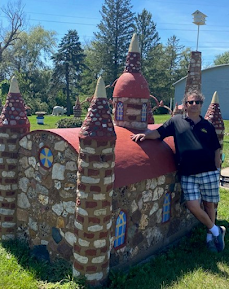
There were a couple of reasons we picked Wabasha, Minnesota as our destination for a week, and one of those reasons was the easy access to Wisconsin by crossing the Wabasha-Nelson truss bridge. This was a private bridge with a toll until 1947 when the Minnesota & Wisconsin highway departments bought the bridge for $ 400,000.00. The point here is that the bridge gave us access to towns on both sides of the Mississippi River.   And it was in Fountain City, WI, that I finally found the quintessential side-show attraction that I could not ever have envisioned when picturing our future RV travels.  I had often related amusing anecdotes of Judy and me stumbling onto the unusual attractions off the beaten path which might include the “biggest ball of twine”, “largest elastic band”, or maybe even the “largest Paul Bunyan statue”.  But never in my wildest imagination would I have ever dreamed up what we were destined to find at the Prairie Moon Sculpture Gardens.

Prairie Moon Sculpture Gardens was the creation of Herman Rusch (1895–1995), a retired farmer, who opened this roadside museum in Cochrane, Wisconsin.  Concerned that the grounds of the museum were barren, Rusch built his first concrete and stone planter circa 1958. That effort led to two new engrossing interests: the creation of huge sculptures and related flower beds. Rusch said that he “just kept on building. You don’t ever know where it will end up when you start.” Without any formal art training, he became a consummate craftsman and artist, searching local quarries for appropriate stone, and developing exceptional masonry skills.  By age 89, Rusch had created nearly 40 sculptures. These included a “Rocket to the Stars,” a Hindu temple, dinosaurs, even a miniature mountain. Sometimes Rusch added color to the freshly mixed concrete; sometimes he painted the surfaces. He embellished the sculptures with seashells, bits of broken bottles, and shards of crockery and mirrors.  


A weird and wonderful museum and garden, just sitting there on a side road waiting to be discovered.  And discover we did.

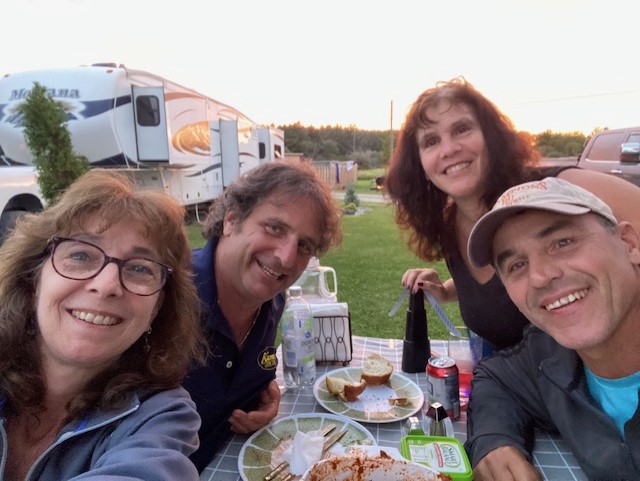
I guess you could say that the other reason we picked Wabasha is so that we could visit with friends, Kristine & Bryan, as they were also camping in Wabasha.  And by this time on our trip it was good to be able to socialize with other people.  Really good!  Don’t get me wrong, Judy and I are very well acquainted, but the richness of the human experience is being able to socialize with others, and I would say that we noticed after several weeks on the road that we were living a bit of a cloistered lifestyle.  So being able to spend time with another couple, listening to their stories, enriched our experience.  Kristine & Bryan were warm and inviting, and we had a great time talking, hiking, dining, and bowling with them. 

We had ventured as far west as this trip was planned, and after six weeks we were changing direction and heading back towards the east coast on a more northerly route featuring the Great Lakes.   We extended our stay in Wabasha by a day, but eventually we had to pack up and leave for our drive due east to Green Bay, WI, and the Brown County Reforestation Campsite.  Interesting fun fact; the recreational area took on the name of “reforestation” because in 1948 a passing train threw some sparks and caused a forest fire that wiped out 80 acres of forest.  So, the County built a prison camp in the area to plant trees and reforest the area.  Over 250,000 trees were planted in the early 1950’s and 70 years later there is a wonderful wilderness and recreational area.  Over 1,000 acres of wooded area, trails, and bodies of water, the Reforestation Camp offers a variety of outdoor activities, including miles of scenic trails for hiking, biking, and horseback riding (ohh, and one of the few places with POOR cell reception, no big surprise there).  So, of course we walked the trails. That seems to have become the de-facto theme of this trip.

The best part of this campsite was the proximity to the city of Green Bay, which was about 12 miles south of the campsite and an easy drive. Green Bay is a fantastic small city, easy to navigate, with a distinct charm.  And although we never had a chance to visit the “Frozen Tundra of Lambeau Field”, we were lucky enough to be downtown on a Saturday morning whilst the “farmers’ market” was taking up around 4 city blocks.  This place was packed with both vendors as well as people.  At 10:30 am.

There was plenty to do and see in Green Bay, but there were two absolutely fantastic museums that caught our attention.

  • The National Railroad Museum was by and far the best display of old railroad engines, cars, and equipment we have ever seen.  The museum is the only congressionally designated railroad museum in the United States and features over 70 rail cars and locomotives.  A big museum in 3 massive, shed type buildings.  Best part is that we got lots of great pictures at the controls of enormous steam powered locomotives.


  • The Automobile Gallery & Event Center was a gem of a museum.   Wow!  Steven was constantly texting out pictures to car enthusiast friends back in Massachusetts.  At this museum there was 100 years of automotive history and beauty ranging from an ultra-rare 113-year-old Cadillac Model T Touring Car to a Mercedis AMG 6.3 V-8 with over 500 hp and gulf wing doors.  An awesome collection of Corvettes including a very rare split back 1963 Corvette Stingray in red.   Or maybe a 1979 VW Cabriolet in white is more you’re taste.  And don’t even get me started on the “muscle cars” of the 60’s like the Pontiac GTO, Chevy Malibu, Buick Skylark or Oldsmobile Tempest (anybody remember the movie with Danny Devito, “My Cousin Vinnie).  We were suitably educated, entertained, and inspired by this museum. 


Because we had added a day to our Wabasha stop, after a short 5-day visit to the Brown County Reforestation Camp we were packing it up for a long drive up and over the top of Lake Michigan.  A 250-mile drive northeast into the Michigan Upper Peninsula and on into Mackinaw City.  But in order to get to Mackinaw City, I had to cross the 5th longest suspension bridge in the world.  The Mighty Mac, as the locals call it, is an engineering marvel; but to be honest, one scary ass ride with a 40-foot trailer weighing 4 tons.  After what I would describe as a successful “white knuckle” ride over the bridge, we arrived in Mackinaw City, MI.  And you’ll have to read our next post to find out what Mackinac Island was like as we tell… the Rest of the Story..

Troll Hunting in Rhode Island: A Small-State Adventure Close to Home.

Before summer slips completely into the rearview mirror, I wanted to pull back into the blog lane and bring you along for a quick catch-up o...