Monday, July 28, 2025

In Darling Lake, NS, We Played “Washer Toss” Which Had Nothing To Do With Maytag® Or Whirlpool®!

Witness firsthand Judy’s determination and concentration as she tosses a flat hub washer painted yellow across the playing field and into the box. The game is called “Washer Toss” and it’s a combination of Horseshoes and Corn Hole, played with washers. If I were to utter the game name, “Washer Toss”, what comes to mind? Did any of you think about the hardware item called a washer? Or did any of you think about a Maytag clothes washer? Would it surprise you to learn that when I first heard the term “Washer Toss”, I did not think about the hardware item?  Nope, that’s not exactly where my head was. I thought that these people, these Canadians, got together on a Friday afternoon to toss Maytag and Whirlpool washers around - For FUN - while betting on the outcome! These are some mighty strong people, or this is a very strange game. Upon further clarification I was informed that these were really 3” hub washers weighing about a pound, being tossed into a box.  Boy, was I relieved! 😅 We laughed quite a bit afterward. Judy and her teammate, Raymond, made it to the semi-finals before being eliminated by the team who won the entire $20 pot. We had so much fun with these oh so friendly, seasonal campers.

This was our second visit to Darling Lake, and the exchange about the game described above actually happened on our first trip in 2017.  We were so limited in what we could see on our first trip, including being able to participate in the Friday night “Washer Toss” game, that we vowed to return.  And now we have, and this time with a weeks’ worth of time to get to know some of the towns along the southern Atlantic coast of Nova Scotia. First and foremost is the town of Yarmouth which in the early 20th century was the gateway to Nova Scotia. The establishment of the Yarmouth ferry terminal and the start of the Yarmouth-Maine ferry service in 1956, solidified its status as a gateway for tourists and goods between Nova Scotia and New England.


Much of what was just recited was learned while we visited the Yarmouth County Museum, a National Heritage Conservation award winning museum and archive run by the Historical Society.  What a treasure trove of interesting artifacts.  There is an extensive collection of painted pictures of sailing vessels, as well as an over 8 foot tall, 1st Order Fresnel Lighthouse lens that could throw a beam of light nearly 10 miles into the Atlantic. We have visited many lighthouses in our travels and seen several Fresnel lenses but this is the only 1st Order lens we have ever seen. It’s a technology that dates back to1822. 

Yarmouth County Museum had a couple of interesting peripheral historic presentations that we made time for. Ahh, the benefit of having time without a particular agenda. Down on Killam Wharf lies Killam Brothers Shipping Building. Here we found a remarkably preserved 1800s Shipping Office which played a major role in the financial growth of Yarmouth and the area. The shipping office remains largely unchanged since the Killam Brothers ran their fleet of sailing vessels from this office in the 1800s. There are unique displays, including the original half model of the 1861 ship “Research”, complemented by the story telling of its “Voyage of Many Rudders”.  Also on view are ledgers and daybooks from the 1800s and early 1900s. This was a very interesting side attraction.   

Have you heard of the Fuller Brush Company? Founded in 1906 by Alfred C. Fuller, the company achieved remarkable success through its door-to-door sales model and earned a reputation for quality products. The Fuller Brush Company remains in operation to this day. Notably, Mr. Alfred A. Fuller maintained a summer residence in Yarmouth, featuring a beautifully maintained English rose garden. The Yarmouth Historical Society now offers guided tours of this well-preserved home, which includes original garments, tableware, and linens. Judy and I were impressed by the company's legacy and chose to experience the door-to-door presentation ourselves.


Port Maitland Beach & Miles of Soft Sand

Occasionally, mother nature gives us an ideal beach day. On such days, we gather our beach chairs & umbrella from the loft, pack a lunch, snacks, and sunscreen, and travel to the beach. After researching, Judy suggested driving a few miles north to Port Maitland Provincial Park. What a great choice. Here we found a wonderful mile long sandy beach, with changing rooms and a bathroom easy walking distance from both the beach and the parking area. It may just be the incredibly great weather we were experiencing, but this beach was gorgeous.  The beach was so large it was impossible to feel crowded. This area of Nova Scotia is also part of the Bay of Fundy, and therefore subject to a 14-foot difference between low & high tide.  At low tide the beach really opens up as the tide retracts, exposing over 2 football fields of soft dense sand to stroll along.  It was a great beach on a fantastic beach day.

Leif Erikson Park with Cape Forchu Lighthouse

If you were to search the internet for the best sightseeing attractions to see in Yarmouth, most certainly a visit to the Cape Forchu Lighthouse would appear on the list. The Cape Forchu Lighthouse, located in Cape Forchu, NS, is known for its distinctive "apple core" design and its role in guiding mariners for over 180 years. The lighthouse sits on a rocky headland within Leif Erikson Park, which provides walking trails and scenic ocean views. We spent a lovely early afternoon walking the trails and getting some of the best views of Yarmouth harbor.


Yarmouth is also the location of the Nova Scotia Firefighters Museum. The Firefighters Museum presents the history of firefighting in the province. The museum contains a variety of antique fire engines. The upper level displays older, manually operated fire equipment, while the first floor houses newer horse-drawn and steam-powered firefighting apparatus.

Firefighters' Museum of Nova Scotia

I recognize that I have shared these sentiments in an earlier blog post, but they are worth reiterating: "We meet the friendliest people on our travels." This aspect genuinely stands out as one of the greatest pleasures of our journeys. Whether it be encountering people at the campsites, or meeting people on one of our many walking tours, there’s always someone new to start up a pleasant conversation with. Now you may be inclined to think it’s because I’m

such a “chatty Cathy”, but I can assure you that you would be wrong…, sometimes.  Here is the scenario. Judy and I are sitting at our picnic table after having dinner outside the RV.  The sun is setting over Darling Lake, the warm breeze is keeping the bugs away, and there is a group of fellow campers walking slowly back to their campsites up the hill. Immediately, salutations are exchanged, and then one of the group stops at the table to talk with us. Where are you from? How long are you here? These are some of the opening questions that lead to longer exchanges. Mack, as we learn his name, is carrying a bottle of Disaronno liquor that he has recently come into possession of. And he wants to share. We grab our little green glasses, and we partake.  Even Judy.  But then we ask Mack, “Have you ever had Peanut Butter Whiskey from Tennessee?”  The answer is obviously, NO.  Then Judy pours a round of her favorite whiskey, and Mack loves it! So much so that he takes a picture of the label for future reference. Mack shares some ideas for excursions and sightseeing in Halifax, our next stop, which we dutifully record for future investigation. Eventually Mack bids us goodbye, wishes us to have safe travels, and hopes to see us again if we ever choose to camp at Darling Lake again. But not before we snap a quick selfie just to prove it really happened as we tell… the Rest of the Story.

Monday, July 21, 2025

We’re visiting lots of Saints! St. Andrews, St. John & St. Stephen, in New Brunswick, Canada

After leaving the United States following a visit to Acadia National Park, we drove northeast and soon crossed into Canada’s Maritime Provinces. This region in eastern Canada includes New Brunswick, Nova Scotia, and Prince Edward Island, and is known for its coastal scenery, European historical background, and diverse culture. The first stop was St. Andrews by the Sea, which extends on a peninsula into the Bay of Fundy. The town displays significant British influence, as is indicated by street names such as Prince of Wales Street, William Street, Queen Street, King Street, and Edward Street—all referencing members of the British monarchy. St. Andrews was originally settled by British Loyalists who left Massachusetts to avoid persecution at the end of the American Revolutionary War.


We had the most amazing campsite on the shores of Passamaquoddy Bay which is an inlet off the Bay of Fundy, between Maine and New Brunswick. And our campsite faced the Bay. This was truly a spectacular sight for watching the sea.  Some days the bay was totally socked in with fog. From our campsite we could not see the ocean 200 feet away. Other days we could see 6-7 miles across the bay to Mascarene, New Brunswick. There were a number of very warm days, but in the afternoon the winds would turn onshore, really cooling down the camper but making it a little too windy to eat outdoors.


From this campsite, we observed the phenomenon of astronomical tides at the Bay of Fundy. The tides in the Bay of Fundy fluctuate by nearly 53 feet within a 6.4-hour period between low and high tide. This significant tidal variation results from the bay's distinctive funnel shape and its resonance with oceanic tides. These tidal ranges are regarded as the greatest in the world and present an impressive natural spectacle on a daily basis. On one afternoon during low tide, we traversed toward the center of Passamaquoddy Bay. The receding shoreline revealed a rocky seabed extending approximately three-quarters of a mile from land. The walk was challenging, marked by uneven rocks, anchored seaweed, and occasional jellyfish. Although we did not reach the furthest visible point, we advanced far enough into the bay that GPS coordinates indicated our position in open water.


If the astronomical tides in the bay haven’t caught your interest, consider this: we crossed to Ministers Island via a sand bar exposed only for about four hours at low tide. Ministers Island was originally owned by Sir William Van Horne, who was president of the Canadian Pacific Railroad. The estate is magnificent and includes a chateau style barn, which Van Horne used to breed Clydesdale horses. The manor home has been remarkably restored and preserved, and there is also a stone observation point and the remnants of a salt-water bath house.  We visited one evening to enjoy a small venue concert of Fiddle & Follk music. Once over, we had to make a beeline for the exit road so as not to get stuck on the island when the road got swallowed up by the incoming tide.

Bar Road, St Andrews leading to Ministers Island at Low Tide

 We dedicated considerable time to exploring S.t Andrews on foot. As a compact and easily navigable community, it was well-suited for walking. Adjacent to the campsite lies the Van Horne Walking Trail, an extensive network spanning nearly three miles, featuring notable points such as Pagan Point Nature Preserve and Katy’s Cove Beach. We traversed this trail multiple times and consistently varied our return routes to the campsite.

A person wearing sunglasses and a hat

AI-generated content may be incorrect.
Judy at Katy's Cove Beach
Steven in Pagan Point Nature Preserve

We did travel beyond the town of St Andrews. We found several other towns and hamlets, also beginning with the designation of St., to be equally noteworthy and entertaining to visit. So, let’s begin in no particular order. 

           St. George is located a short distance northeast of our position, and we planned to observe the run-of-the-river hydroelectric dam on the Magaguadavic River. (This type of power plant operates using the river's flow rather than storing water in large reservoirs.) The viewing area and fish bypass windows were closed due to renovations. However, across from the dam, the Ducks Unlimited Walking Trail was accessible. We walked along the Marsh Trail around Ducks Unlimited Marsh and returned. During the walk, an Osprey was observed flying from its nest to a tall tree in the marsh.


             St. Stephen is situated a short distance southwest of St. Andrews and is home to the Ganong Nature Park. This impressive 350-acre property offers views of the confluence of the St. Croix River and St. Croix Island. The park features numerous walking trails; visitors can enjoy a picnic lunch and spend the afternoon hiking to a scenic overlook of Oak Bay.

Atop the overlook after hiking up Ganong Nature Park, St. Stephen, NB

·       


S

        St. John is located an hour north by car. As a vibrant port city on the Bay of Fundy, it is renowned for its rich history and harmonious blend of traditional charm with contemporary conveniences. Being one of Canada's oldest incorporated cities, St. John continues to experience significant development. The city features a convention center, Town Square, Town Market, and the unique Area 506—a waterfront destination built from shipping containers. Area 506 includes retail shops, a performance venue, a waterfront container lounge, food trucks, public art installations, and pop-up activities. Our visit began here, where we met our tour guide, Pete, for the St. John’s 2½-hour walking tour. Pete was an amazing tour guide. Really knowledgeable primarily because he owned and operated a Pub in the downtown area for many years. He knew everybody and provided both historic and current information on the city. The tour led us away from the water, uphill through the city on a pleasant morning, and concluded with lunch at Market Square.

The visit to St. Andrews by the Sea was included in an itinerary featuring locations previously visited in August 2017. Multiple stops on this trip return to places from that earlier 10-day, 1,400-mile journey. During that time, Judy and I discussed retirement and considered traveling the country in an RV, despite having no prior experience with camping or RVs. This trip went so well, it was perfect.  It was everything we expected and oh so much more. I can honestly say that after that trip Judy and I were hooked on the RV lifestyle. We had only one regret. The trip was too SHORT!  We wanted more time. We effectively addressed that issue during this trip by scheduling an extended visit. We are now proceeding to another familiar destination from our 2017 travels—Yarmouth, Nova Scotia. This leg of the trip involves taking a ferry from St. John, across the Bay of Fundy, to Digby, Nova Scotia. From Digby, it is a short drive to Yarmouth, where we will stay at a campsite we previously enjoyed during our 2017 visit. That’s a story to be told in my next blog post as we tell… the Rest of the Story.

Monday, July 14, 2025

Acadia National Park amazed us, and we also caught up with Paul Bunyan.

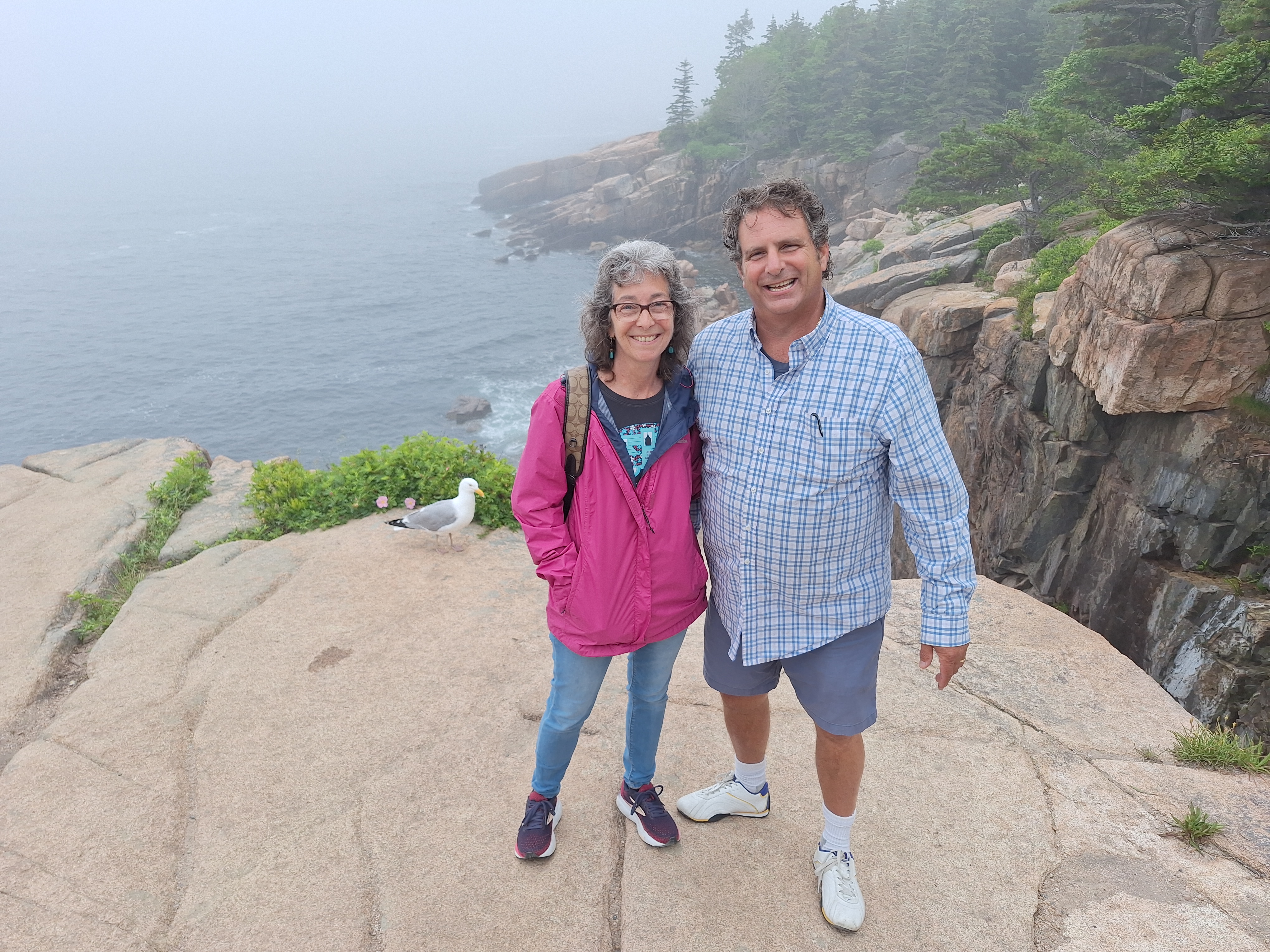
Strap yourselves into your travel chairs, we’re back on the road and we couldn’t be happier to be sharing our travel experiences with you. In this post, we begin our journey affectionately called “Canada or Bust”. First stop, a place people call “down east Maine”. Downeast Maine refers to the eastern coastal region of Maine, stretching from the town of Ellsworth eastwards to the Canadian border. We’re talking about the rugged and rocky Maine coastline, with its historic fishing villages, and the first National Park east of the Mississippi, Acadia National Park. And OMG, what a park. As awe-inspiring and picturesque as Yellowstone. It seems Mother Nature substituted spouting geysers and the fantastic colors of the “Grand Prismatic Spring” with thunderous sounds of the sea crashing into the rocky coastline at “Thunder Hole”, and the majestic granite outcropping of “Otter Point”.  

Judy, Morgan & Steven Walking to Echo Beach


Acadia National Park is located on the 108 square mile Mount Desert Island. The park encompasses much of the island, which also includes several small towns such as Bar Harbor, Northeast Harbor, and Southwest Harbor. Our RV campsite in Southwest Harbor abutted the Acadia Park hiking trail network and we had easy walking access to Echo Lake Beach and the Beech Mountain Trail. Which is where our story will begin, because we returned to this lovely spot several times for hiking and to go to the beach with chairs in hand.


Beech Cliff Trailhead


Echo Lake is a picturesque freshwater lake encompassing 236 acres and reaching depths of approximately 66 feet. Motorboats are prohibited, maintaining the exceptionally clean water, so you can actually see the minnows swimming by the shoreline. Additionally, the lake's water temperature is notably warmer than that of the ocean.

Acadia National Park is a distinctive destination that highlights the rugged coastline of Maine. The park encompasses a diverse array of landscapes, including mountains, forests, and rocky shores.  As the only national park in the northeastern United States, Acadia offers remarkable scenery, vibrant sunrises and sunsets, abundant wildlife, and numerous opportunities for outdoor recreation. With such a wide range of activities available, we endeavored to document as much as possible during our visit. We were also pleased to have our daughter, Morgan, and her friend, Dani, accompany us for several days, which contributed significantly to the overall momentum of our activities.  

We spent much of a day at Sand Beach, a highly frequented location that requires early arrival due to its popularity. Nestled between impressive granite cliffs, the beach features sand composed primarily of fine shell fragments and is bordered by notably cold ocean waters, with temperatures typically in the lower 50-degree range. From our position beneath a beach umbrella on the 290-yard stretch of shoreline, we enjoyed remarkable views of the surrounding granite cliffs and adjacent pine forests, while waves from the Atlantic Ocean consistently broke upon the shore.

Sand Beach


You cannot go to Acadia without taking a car ride around Park Loop Road. This is a 27-mile-long loop around the outer edge of the park which features some of the most stunning scenery. There is Thunder Hole, where people go at high tide to hear the noise made from the waves crashing into a rock formation that creates a thunderous roar. Further down Park Loop Road there is a place called Otter Cliffs. At 110 feet above the ocean, they are one of the highest coastal headlands in North America. There are so many scenic overlooks and breathtaking views, it would be hard for me to do them all justice. The whole loop is a must do for any trip to Acadia.


Rodick's Lobster Roll atop Cadillac Mtn
Cadillac Mountain Road is another notable attraction in Acadia, featuring a 3.5-mile drive up the rear side of Cadillac Mountain to its summit, which stands at 1,527 feet above sea level. While not the highest peak we have ascended by car, it offers some of the most remarkable views, including clear vistas of Bar Harbor, Bar Island, Bald Porcupine Island, Turtle Island, and much of the Mt Desert Narrows inlet. The most sought-after time to visit Cadillac Mountain is at sunrise, as it is renowned for being the first location in the United States to witness the sun rise. Due to high demand, vehicle access is regulated through a “timed entry” system, requiring visitors to secure a reservation online, especially for sunrise slots around 5:20 am. Instead of opting for sunrise, we scheduled our visit during sunset, successfully obtaining a 6:00 pm entry slot. We drove to the summit with a picnic dinner featuring lobster rolls, salad, and dessert, and observed the sunset at 8:20 pm. The experience was truly memorable, and the view from the summit at sunset will remain unforgettable.


Wait, I’m not quite done. There’s just so much to do in Acadia, and whilst I still have your attention, let me tell you, as briefly as I can, how we spent a morning walking around Jordan Pond on Jordan Pond Path. This 3.3 mile trail circles the glacially formed pond, which is noted for its clear freshwater and views of surrounding mountains. The path follows the shoreline and includes segments along boardwalks, sections with rocky terrain, and areas featuring both wooden and stone bridges.

Steven, Dani, Morgan, Judy at Jordan Pond

Steven, Morgan, Dani, Judy at Paul Bunyan Statue

Without a doubt, the highlight of Morgan’s visit was attending “Timber Tina's Great Maine Lumberjack Show.” This engaging event features two teams of lumberjacks competing in a series of 12 events, including wood chopping, sawing, tree climbing, ax throwing, and log rolling. Over the course of the 90-minute performance, attendees also receive an informative overview of the logging industry in the 18th century, highlighting Maine's historical significance as a leader in the timber trade. Timber Tina serves as the host and master of ceremonies for the event. Her given name is Tina Scheer, and she has achieved distinction as a world-class competitor, significantly contributing to increasing opportunities for women in lumberjack competitions. Timber Tina also provided information regarding the Paul Bunyan statue located in downtown Bangor, ME. For anybody who has followed this blog, you know that I'm drawn to quirky sideshow attractions. And I have a particular soft spot in my heart for Paul Bunyan, who I first spotted in Bemidji, MN. (See blog post “The Charming City of Duluth, MN and a visit with Paul Bunyan”, posted July 22, 2024.) So, when I heard that there was a 31-foot-tall statue of Paul Bunyan in Bangor, well we all just had to go. It did not disappoint!

 This stop was mostly about the National Park itself, but we did do some other fun things both on and off the Island. We took a “Bar Harbor Ghost Tour” where we heard ghost stories of the Wabanaki Indigenous spirits, as well as personal accounts of ghostly activity in and around the Bar Harbor area. Whilst in Bangor, ME, we took time to visit the Orono Bog Boardwalk. This is a one-mile loop trail located in the Bangor City Forest, which extends into the Orono Bog, a unique ecosystem with its diverse vegetation and wildlife.

Readers of this blog may be aware that, generally, Judy and I spend about a week camping in one area. Initially, during our RV travels, we moved every 4 or 5 days but have since extended our stays to allow for a slower pace. On this current "Canada or Bust" trip, our stops range from 8 to 9 days, providing additional time to explore local areas and absorb the local flavors. Our first stop is an excellent example of this newly found freedom. On this stop, with the extra time we got to travel around not just in Mount Desert Island & Acadia National Park but also north and into Bangor, ME. We’re off to an amazing start to this trip and we are taking you all along for the ride.  Let’s see what we find on our next stop in St. Andrews by the Sea in New Brunswick, Canada as we tellthe Rest of the Story.


Santa Fe Seduction: Artful Adventures, Cultural Surprises, & Stories That Steal Your Heart.

We’re headed east. That’s right—after a long stretch, our compass is finally pointed toward home. As we reach roughly two-thirds of the way ...